A Form 5472 Information Return Does Not Calculate Every Tax the Owner Might Owe
· 7 min read
The practical answer
A filing packet can answer a reporting requirement without answering every tax question raised by the owner or the business. Keep the scope visible when reviewing Form 5472 so a prepared information return is not mistaken for a complete personal or business tax analysis. A foreign-owned U.S. disregarded entity is a domestic disregarded entity wholly owned by a foreign person. Its treatment as a corporation for these purposes is limited to the reporting requirements related to section 6038A.[1, p.2]
Scope and the records behind the answer
The discussion follows the entity, form and transaction conditions identified below. The same label on a different form can have a different purpose. Keep the relevant entity and reporting period visible while you compare the requirements, and treat each stated exception as part of the rule rather than an optional footnote.
Official sources checked: 2026-11-09. Annual tax-year forms and continuously revised forms are identified separately in the references.
A side-by-side preparation table
| Item or question | Official rule or instruction | Conditions and limits | Source |
|---|---|---|---|
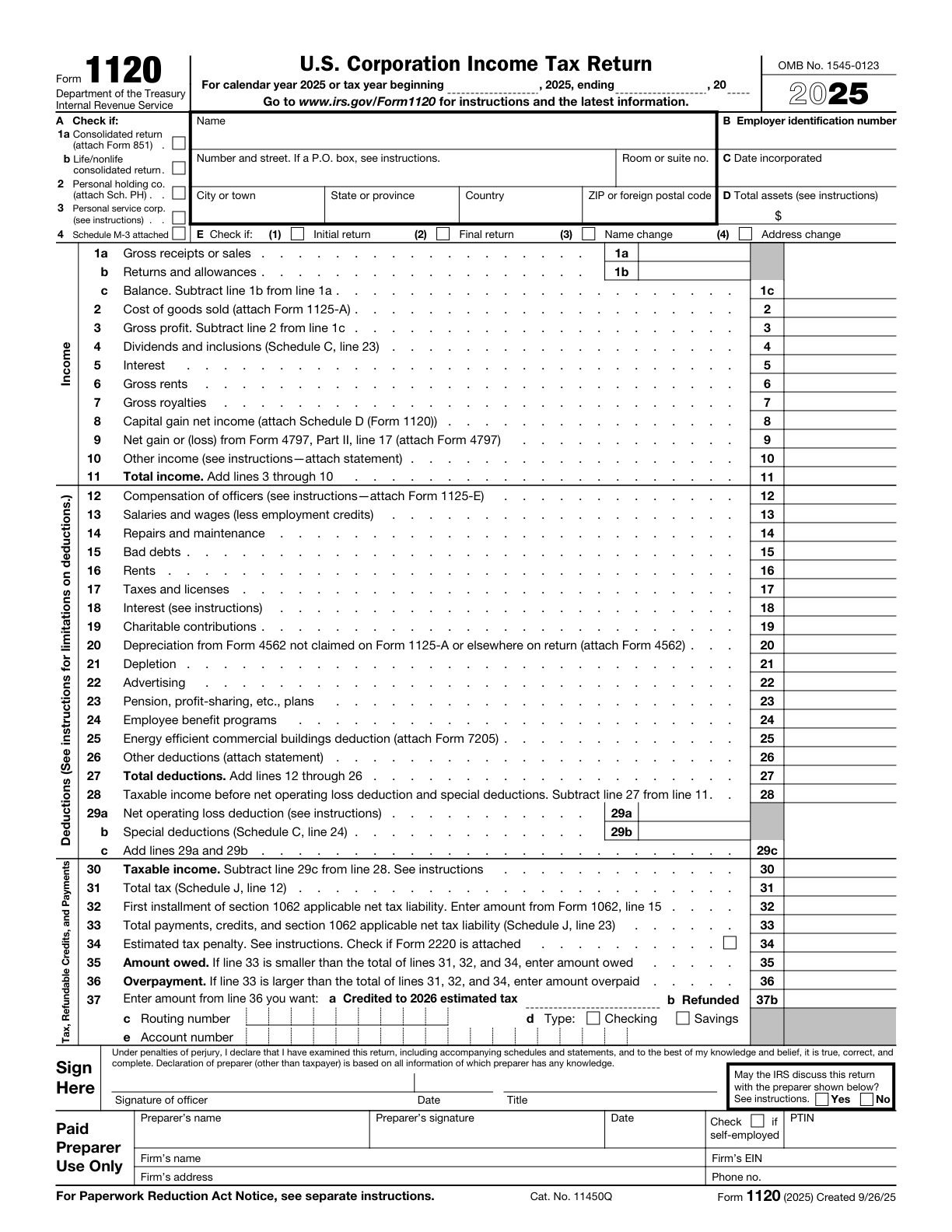
| Proforma only fields | The special pro forma Form 1120 instructions for a foreign-owned U.S. DE require its name and address and items B and E on the first page. Do not automatically expand this into the full income-tax return for an ordinary C corporation. | Apply this entry within the entity, form and period described here; read the cited passage for the surrounding context. | [1, p.2] |
| Proforma top mark | Write "Foreign-owned U.S. DE" across the top of the pro forma Form 1120 to identify the special filing package described in the Form 5472 instructions. | Apply this entry within the entity, form and period described here; read the cited passage for the surrounding context. | [1, p.2] |
| De proforma required | A foreign-owned U.S. DE subject to Form 5472 filing attaches Form 5472 to a pro forma Form 1120 and files by the Form 1120 due date, including a valid extension. | Apply this entry within the entity, form and period described here; read the cited passage for the surrounding context. | [1, p.2] |
| Foreign owned us de definition | A foreign-owned U.S. disregarded entity is a domestic disregarded entity wholly owned by a foreign person. Its treatment as a corporation for these purposes is limited to the reporting requirements related to section 6038A. | Apply this entry within the entity, form and period described here; read the cited passage for the surrounding context. | [1, p.2] |
| Field/section 1n: Country(ies) under whose laws the reporting corporation files an income tax return as a resident | Identify the countries under whose laws the reporting entity files income-tax returns as a resident. Do not substitute the owner's nationality. | Apply this entry within the entity, form and period described here; read the cited passage for the surrounding context. | [2, p.1] |
| Field/section E(2): Final return | Identify a final return using the applicable item E box. Dissolution does not by itself establish that all federal tax matters are complete. | Apply this entry within the entity, form and period described here; read the cited passage for the surrounding context. | [3, p.1] [1, p.2] |
Work through the official requirements
Proforma only fields
The special pro forma Form 1120 instructions for a foreign-owned U.S. DE require its name and address and items B and E on the first page. Do not automatically expand this into the full income-tax return for an ordinary C corporation.[1, p.2]
Proforma top mark
Write "Foreign-owned U.S. DE" across the top of the pro forma Form 1120 to identify the special filing package described in the Form 5472 instructions.[1, p.2]
De proforma required
A foreign-owned U.S. DE subject to Form 5472 filing attaches Form 5472 to a pro forma Form 1120 and files by the Form 1120 due date, including a valid extension.[1, p.2]
Foreign owned us de definition
A foreign-owned U.S. disregarded entity is a domestic disregarded entity wholly owned by a foreign person. Its treatment as a corporation for these purposes is limited to the reporting requirements related to section 6038A.[1, p.2]
Field/section 1n: Country(ies) under whose laws the reporting corporation files an income tax return as a resident
Identify the countries under whose laws the reporting entity files income-tax returns as a resident. Do not substitute the owner's nationality.[2, p.1]
Field/section E(2): Final return
Identify a final return using the applicable item E box. Dissolution does not by itself establish that all federal tax matters are complete.[3, p.1] [1, p.2]
Field/section 6e: Country(ies) under whose laws the ultimate indirect 25% foreign shareholder files an income tax return as a resident
List the countries under whose laws the largest ultimate indirect 25% foreign shareholder files income-tax returns as a resident. Attach the ownership-attribution explanation required for the indirect-shareholder fields.[2, p.1] [1, p.5]
This applies when: Complete a shareholder group only when the corresponding direct or ultimate indirect 25% foreign-shareholder category, number of shareholders and requested information actually apply. Do not repeat a sole owner automatically in every group.
Field/section 7e: Country(ies) under whose laws the ultimate indirect 25% foreign shareholder files an income tax return as a resident
List the countries under whose laws the second-largest ultimate indirect 25% foreign shareholder files income-tax returns as a resident. Attach the ownership-attribution explanation required for the indirect-shareholder fields.[2, p.1] [1, p.5]
This applies when: Complete a shareholder group only when the corresponding direct or ultimate indirect 25% foreign-shareholder category, number of shareholders and requested information actually apply. Do not repeat a sole owner automatically in every group.
De tax year
A foreign-owned U.S. DE uses the tax year its owner uses for U.S. tax filing. If the owner does not have such a tax year, the DE uses a calendar year.[1, p.2]
An illustrative preparation scenario
In this hypothetical preparation example, a foreign owner asks whether the amount on the information return settles every possible tax liability. The preparer identifies what the proposed packet reports and lists the separate income, residency, or classification questions that require their own review rather than guessing a tax result. The preparer checks three points: What does this reporting package cover? Which other tax questions remain outside it? Is a reporting amount being treated as a tax calculation? The file remains a working comparison until the relevant facts and applicable instructions have been checked together. No agency outcome is assumed.[1, p.2]
This is a planning illustration, not a statement that a particular filing has been accepted or that an entity qualifies for a tax result. Use the source-backed distinctions above to decide what information still needs to be established before a form is completed.
A review sequence you can actually use
- What does this reporting package cover?
- Which other tax questions remain outside it?
- Is a reporting amount being treated as a tax calculation?
Write down the answer and the record that supports it, rather than marking a question complete because a field contains text. When two records disagree, identify whether the difference concerns the entity, an individual, the reporting period or the type of change. That makes the remaining question specific enough to resolve against the relevant instruction.
Keep the scope of a preparation service separate from the government requirement. A service intake question may gather information for a workflow; it does not create an exception, extend a deadline or determine whether a transaction is reportable. The cited government material remains the basis for those conclusions.
Questions to settle before moving forward
How should I check de proforma required?
A foreign-owned U.S. DE subject to Form 5472 filing attaches Form 5472 to a pro forma Form 1120 and files by the Form 1120 due date, including a valid extension. [1, p.2]
How should I check foreign owned us de definition?
A foreign-owned U.S. disregarded entity is a domestic disregarded entity wholly owned by a foreign person. Its treatment as a corporation for these purposes is limited to the reporting requirements related to section 6038A. [1, p.2]
How should I check field/section 1n: country(ies) under whose laws the reporting corporation files an income tax return as a resident?
Identify the countries under whose laws the reporting entity files income-tax returns as a resident. Do not substitute the owner's nationality. [2, p.1]
How should I check field/section e(2): final return?
Identify a final return using the applicable item E box. Dissolution does not by itself establish that all federal tax matters are complete. [3, p.1] [1, p.2]
Official sources and versions
- Instructions for Form 5472 (Rev. December 2024) — Rev. December 2024
- Form 5472 (Rev. December 2023) — Rev. December 2023
- 2025 Form 1120
Get help with the relevant SpeedEIN workflow
SpeedEIN offers preparation and support for the situations described on its service pages. If you would like assistance, review the relevant service scope, supported entities and current availability before ordering. The service does not replace the government’s decision or remove an obligation imposed by the applicable rules.