An EIN Application Is Already in Progress: Coordinate the Handover Before Starting Again
· 6 min read
The answer for this situation
A provider handover becomes difficult when everyone uses the word pending for a different stage. One person means the SS-4 is being drafted; another means it was sent; a third may already have received an EIN. Before authorizing fresh work, create a status register that records which of those events is supported by an actual document. Its purpose is to stop a change of provider from becoming an unnecessary second application. The IRS asks about an EIN previously received, and an assigned EIN is the entity's permanent federal taxpayer identifier; changing the person handling the paperwork does not erase that history. Include a separate column for what remains unverified and another for who is expected to obtain the missing information. An owner can then distinguish an incomplete handover from an incomplete government application, which are different problems requiring different next steps.[1, p.1] [2, p.6] [3]
Which facts change the answer?
Keep three roles separate in the register: the applicant entity, its responsible party and any third-party designee. Except for the government-entity exception, the responsible party is an individual. Signed SS-4 designee authority covers questions about that application and receipt of its new EIN; it ends when the EIN is assigned and released to the designee. The same distinction matters when the old service still holds the only copy of a document. Possession of paperwork is a practical handover issue; it is not proof that the holder remains authorized for every later IRS inquiry. Record the role and the supporting authority separately from the location of the files.[1, p.1] [2, p.6] [3]
The official requirements, compared
| Question or field | Official instruction | Conditions and limits | Source |
|---|---|---|---|
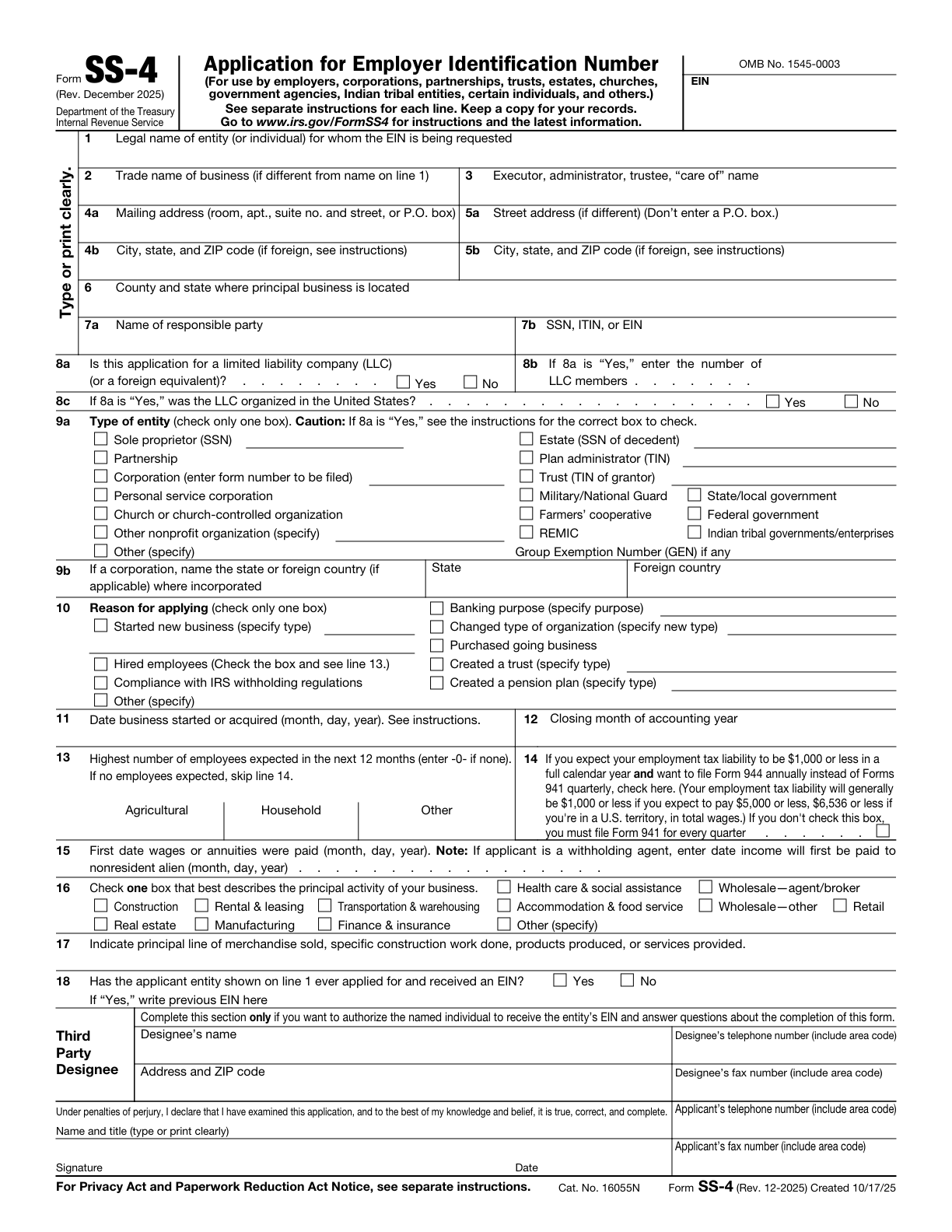
| Previous ein disclosure | Line 18 asks whether the applicant previously received an EIN. If Yes, enter that prior EIN. | — | [1, p.1] |
| Designee scope | The third-party designee may answer questions about the completed SS-4 and receive the new EIN. Signed authorization is required, and that authority ends when the EIN is assigned and released to the designee. | — | [2, p.6] |
| Ein deactivation not cancel | The IRS says an EIN cannot be cancelled, although it can be deactivated; once assigned to an entity it is that entity’s permanent federal taxpayer ID. | State dissolution is a separate agency action, not an automatic IRS deactivation. | [3] |
| Form entity before ein | The IRS instructs someone creating a corporation or LLC to form the entity with the state before applying for an EIN. | This does not mean the state filing itself assigns an EIN. | [4] |
| Legal name | Line 1 requires the applicant's legal name, consistent with the applicable Social Security card, formation document or other legal document. | — | [2, p.2] |
| Responsible party individual | Except for the government-entity exception, the responsible party must be an individual rather than another entity. | Government entities follow the EIN exception in the instructions. | [2, p.3] |
Read the requirements in context
Ein confirmation 147c
The current IRS EIN page lists requesting Letter147C through its business and specialty tax line as a way to confirm an existing EIN.[5]
When this applies: No promise that a preparation service can bypass disclosure or authentication rules.
One ein responsible party daily
The current IRS application page states a limit of one EIN application per responsible party per day.[4]
When this applies: Read current IRS limits before preparing several applications; no workaround or expedited-service claim.
Authorized signer
The authorized SS-4 signer depends on the type of applicant. A foreign applicant may use a person with appropriate authorization to sign.[2, p.6]
Official field SS-4 18: Has the applicant entity shown on line 1 ever applied for and received an EIN?
Answer accurately whether this applicant previously received an EIN. If Yes, enter the existing number.[1, p.1] [2, p.6]
A worked preparation example
This example is hypothetical; it shows how to organize the facts, not an agency decision.
Suppose an owner hires a new preparation service after receiving only a message saying that the application is in progress. The owner can request the latest SS-4, any submission record, correspondence already received and a clear statement of whether a number was assigned. In the register, the owner gives each item a date, a document reference and a status such as draft, submitted or assignment evidenced. A blank assignment column remains unknown; it is not converted into a declaration that no EIN exists. If a number appears in an old message, the owner adds it to the investigation rather than deleting it. This hypothetical handover produces a bounded question for the next helper: identify the existing application's position before recommending another filing. The owner also compares the draft filename and date with the copy identified as submitted. If their addresses or names differ, both versions remain in the file with an explanation of which one was reportedly sent. A transmission reference can document a reported submission event without being presented as an assignment notice. These distinctions keep the new preparer from silently treating the most recent-looking document as the official version or assuming that an unanswered message proves government inaction.[1, p.1] [2, p.6] [3]
Turn the records into a usable filing plan
Finish with a short handover decision: preparation remains unfinished, submission needs clarification, or an assigned number needs confirmation. The IRS lists requesting Letter 147C as a way to confirm an existing EIN, subject to its disclosure and authentication rules. An EIN cannot simply be cancelled to make a provider change easier. Ask SpeedEIN about the relevant support scope using the assembled register; do not assume a new order should produce another application or a promised replacement notice. Give the incoming helper a specific task and a defined stopping point. For example, the assignment may be to reconcile the copies and explain which evidence is missing, rather than to prepare a replacement application immediately. Keep the conclusion dated so a later notice can be added without rewriting what was known earlier. If the responsible party is involved in other applications, consider the IRS daily limit when planning any genuinely needed new application; a provider switch offers no exception to that limit.[1, p.1] [2, p.6] [3]
Three checks before you proceed
- Which document establishes the furthest completed stage, rather than merely describing work as pending?
- Does any record show an assigned EIN that must be investigated before another application?
- Who is authorized for the next contact, and does the existing designee authority still cover it?
Related preparation guides
- Two EIN Numbers Appear in One LLC's Records: Build an IRS Identity Reconciliation File
- The LLC Never Started Trading: What to Review Before Deactivating Its EIN
- SS-4 Line 18: Disclose an Earlier EIN Without Assuming It Still Fits
Official sources and document versions
Official source versions checked: 2026-11-10
- Form SS-4 (Rev. December 2025) — Rev. December 2025
- Instructions for Form SS-4 (Rev. December 2025) — Rev. December 2025
- If you no longer need your EIN
- Get an employer identification number
- Employer identification number
Get help with the relevant SpeedEIN service
SpeedEIN provides preparation and support within the scope described on its service pages. Review the supported entity types, required information and current service scope before ordering. IRS decisions, processing and any applicable filing or payment obligations remain governed by the official rules.