Money Went Into and Out of the LLC: Prepare Gross Flows Instead of a Net Balance
· 6 min read
The answer for this situation
A year-end balance can hide the very movements a Form 5472 preparer needs to understand. Money may have entered and left an LLC during the year even when little remains at the end. Build separate inbound and outbound flow controls before trying to populate transaction totals. The controls describe movement directions and their supporting records; they do not create a new tax-netting election or mean every bank entry is reportable. Their practical value is that the reviewer can see which transactions produced a balance, which party was involved and where a form-specific calculation still needs to be applied. Starting with the net amount alone removes that explanation before the reporting analysis has even begun.[1, p.3] [1, p.6] [2, p.1]
Which facts change the answer?
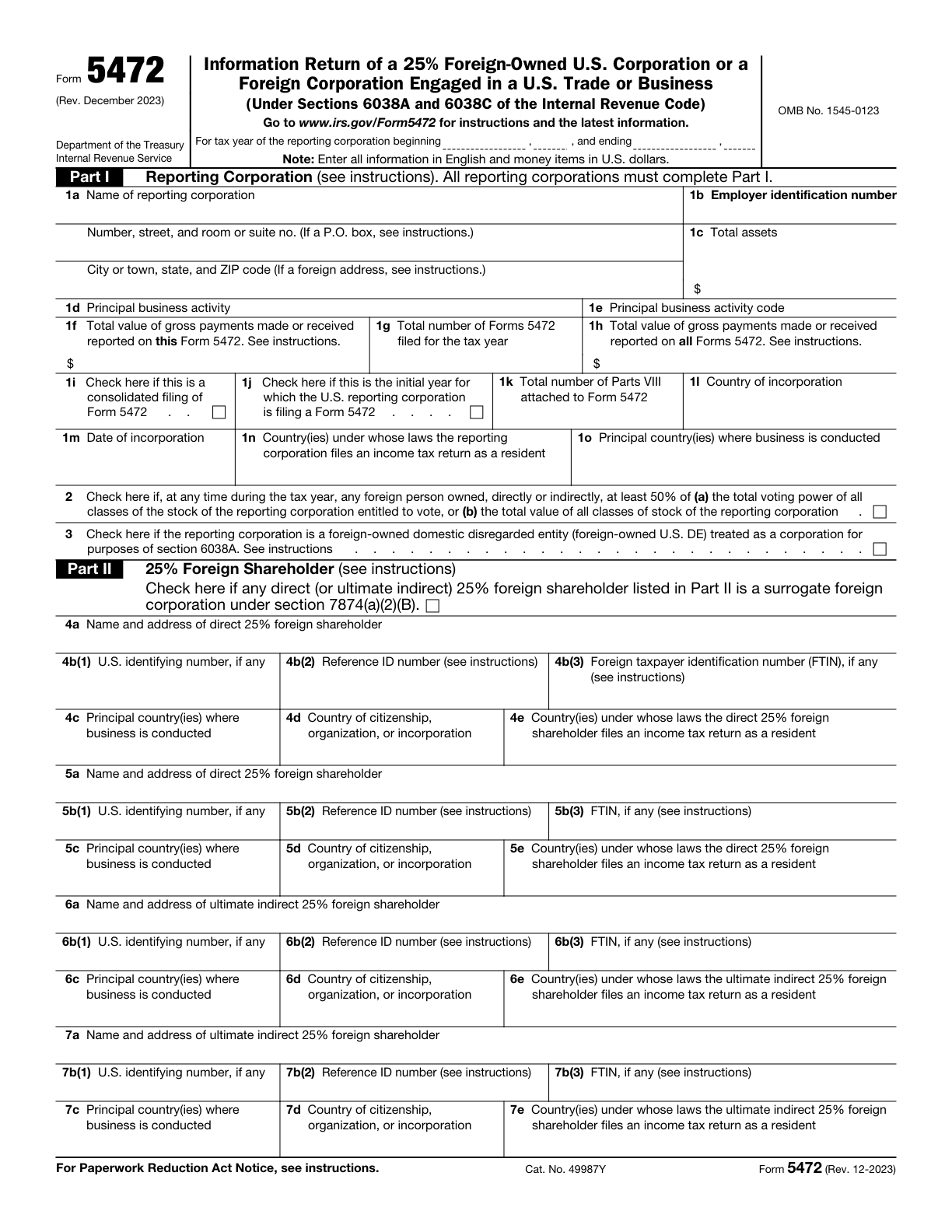
Item 1f concerns the U.S.-dollar value of foreign-related-party transactions on that particular Form 5472, including Part V for a foreign-owned U.S. DE. It is not completed for transactions with a U.S. related party. Item 1h totals the item 1f amounts across the year's Forms 5472; neither field should be replaced with operating revenue or a bank balance. The specified totals within Part IV also require attention to their own lines and apply to foreign-related-party transactions. Keep those instructions separate from the editorial flow-control worksheet so a useful reconciliation is not mistaken for a universal reporting formula.[1, p.3] [1, p.6] [2, p.1]
The official requirements, compared
| Question or field | Official instruction | Conditions and limits | Source |
|---|---|---|---|
| Line1f value | Item 1f is the total U.S.-dollar value of foreign-related-party transactions on that Form 5472, including Part V for a foreign-owned U.S. DE. Do not complete 1f for transactions with a U.S. related party. | — | [1, p.3] |
| Part5 other de transactions | A foreign-owned U.S. DE checks Part V and attaches a description for other specified transactions not reported in Part IV, including receipts and payments connected with formation, dissolution, acquisition, disposition, contributions and distributions. | Foreign-owned U.S. disregarded entity. The relevant transactions have not been reported in Part IV. | [1, p.6] |
| Official field 5472 1f: Total value of gross payments made or received reported on this Form 5472. | Total the foreign-related-party transactions reported on this form, including Part V for the DE. Do not substitute operating revenue for the transaction total. | — | [2, p.1] [1, p.3] |
| Records sufficiency | Keep permanent books and records sufficient to establish the correctness of the federal return and the treatment of related-party transactions, together with the detailed requirements of Regulations section 1.6038A-3. | — | [1, p.3] |
| Reportable transaction trigger | A reporting corporation generally files Form 5472 when it has a reportable transaction with a foreign or U.S. related party during the tax year. Operating revenue alone does not determine the filing requirement. | — | [1, p.2] |
| English usd | Provide Form 5472 information in English and report amounts in U.S. dollars. | — | [2, p.1] |
Read the requirements in context
Separate related party form
Prepare a separate Form 5472 for each foreign or U.S. related party with which the reporting corporation had reportable transactions. Item 1g is the total number of Forms 5472 for that tax year.[1, p.3]
Official field 5472 1h: Total value of gross payments made or received reported on all Forms 5472.
Total the item 1f amounts on all Forms 5472 for the tax year.[2, p.1] [1, p.3]
Official field 5472 22: Total. Combine amounts on lines 9 through 21
Follow the form's specified total for these lines and check that amounts have not been classified twice.[2, p.2] [1, p.5]
When this applies: Part IV concerns transactions with foreign related parties, not domestic related parties.
Official field 5472 36: Total. Combine amounts on lines 23 through 35
Follow the form's specified total for these lines and check that amounts have not been classified twice.[2, p.2] [1, p.5]
When this applies: Part IV concerns transactions with foreign related parties, not domestic related parties.
A worked preparation example
This example is hypothetical; it shows how to organize the facts, not an agency decision.
Suppose a hypothetical statement shows $10,000 moving into an LLC and $6,000 moving out, leaving a $4,000 net movement before considering anything else. The worksheet retains both directions. It does not place $4,000 into a transaction field merely because subtraction is easy, and it does not automatically declare the combined $16,000 to be a reportable total. Instead, each movement receives a source reference, party identity and description of what it represents. Any applicable DE contribution or distribution question is assessed under the relevant Part V conditions, including whether the transaction was already reported in Part IV. Copies of one transfer appearing in several records are linked rather than counted repeatedly. The preparer can then reconcile inbound and outbound controls to the original statement while keeping the eventual form mapping distinct. This example demonstrates arithmetic organization, not a factual filing result. It leaves classification uncertainties visible and does not promise that a netting choice can eliminate reportable transactions. The ending balance remains a useful control, but it is no longer asked to explain every inflow and outflow by itself.[1, p.3] [1, p.6] [2, p.1]
Turn the records into a usable filing plan
Carry the movement-level references into a form-mapping column before preparing totals. A separate Form 5472 is prepared for each relevant related party with reportable transactions; a count of transfers is not itself the form count. Use the form's specified line totals and check that an amount has not been classified twice. Keep the English descriptions and U.S.-dollar presentation tied to the underlying records. If an item's treatment is unresolved, mark it for review instead of forcing the control total to match an assumed tax outcome. The worksheet is meant to explain the data, not determine a transfer-pricing position, withholding consequence or personal deduction. Any SpeedEIN annual-package enquiry should remain within its supported U.S.-formed, single-member DE and nonresident-individual-owner scope. The resulting deliverable is a traceable gross-flow reconciliation and a set of mapping decisions, not a guarantee that a bank balance proves the return correct.[1, p.3] [1, p.6] [2, p.1]
Three checks before you proceed
- Can a reviewer see both movement directions and the source records behind the net balance?
- Have foreign versus U.S. related-party scope and the separate purposes of items 1f and 1h remained clear?
- Are form-specific totals and duplicate-classification checks applied after transaction mapping rather than replaced by worksheet arithmetic?
Related preparation guides
- Personal and LLC Transactions Share a Statement: Build a Reviewable Separation Ledger
- Owner-Paid Bills Before the LLC Bank Account Opened: Reconstruct the Funding Trail
- Owner Contributions Paid in Installments: Reconcile Dates and Totals
Official sources and document versions
Official source versions checked: 2026-11-10
- Instructions for Form 5472 (Rev. December 2024) — Rev. December 2024
- Form 5472 (Rev. December 2023) — Rev. December 2023
Get help with the relevant SpeedEIN service
SpeedEIN provides preparation and support within the scope described on its service pages. Review the supported entity types, required information and current service scope before ordering. IRS decisions, processing and any applicable filing or payment obligations remain governed by the official rules.