Personal and LLC Transactions Share a Statement: Build a Reviewable Separation Ledger
· 6 min read
The answer for this situation
A statement containing both personal and LLC-related activity is a source to analyze, not a ready-made reporting schedule. Start a separation ledger with three working categories: items supported as relevant to the LLC review, items supported as outside that review and items whose connection is unresolved. Those categories organize the evidence; they are not new IRS transaction classifications or deductions. Give each statement line a stable reference and an explanation so another person can follow why it was placed in a category. The useful result is a reviewable decision trail, particularly where an owner paid business-related amounts personally or moved funds between accounts. It avoids two opposite mistakes: assuming every line is a company transaction or discarding the whole statement because it contains personal spending.[1, p.3] [1, p.2] [1, p.6]
Which facts change the answer?
Form 5472 reporting turns on the reporting entity, related party and reportable-transaction facts. A lack of operating revenue does not, by itself, establish a filing exception. For a foreign-owned U.S. DE, specified Part V transactions not reported in Part IV can include formation, dissolution, contributions and distributions. Required records must support the correctness of the return and the related-party treatment. None of these rules says that personal use of an account makes all entries reportable or makes relevant entries disappear. The separation ledger therefore records reasons and gaps while leaving the final tax treatment of uncertain items open.[1, p.3] [1, p.2] [1, p.6]
The official requirements, compared
| Question or field | Official instruction | Conditions and limits | Source |
|---|---|---|---|
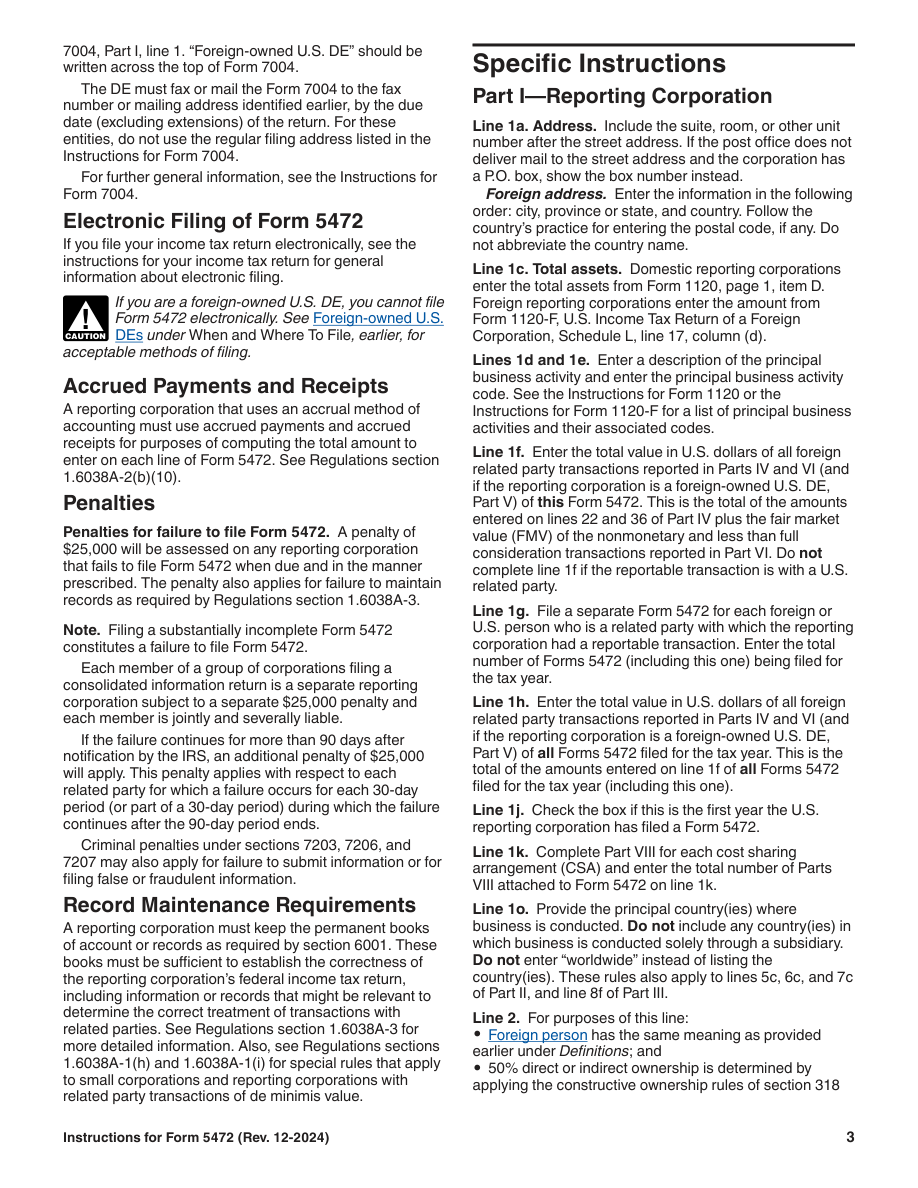
| Records sufficiency | Keep permanent books and records sufficient to establish the correctness of the federal return and the treatment of related-party transactions, together with the detailed requirements of Regulations section 1.6038A-3. | — | [1, p.3] |
| Reportable transaction trigger | A reporting corporation generally files Form 5472 when it has a reportable transaction with a foreign or U.S. related party during the tax year. Operating revenue alone does not determine the filing requirement. | — | [1, p.2] |
| Part5 other de transactions | A foreign-owned U.S. DE checks Part V and attaches a description for other specified transactions not reported in Part IV, including receipts and payments connected with formation, dissolution, acquisition, disposition, contributions and distributions. | Foreign-owned U.S. disregarded entity. The relevant transactions have not been reported in Part IV. | [1, p.6] |
| No transaction exception | Check the no-reportable-transaction exception against Parts IV and VI and, for a foreign-owned U.S. DE, Part V. Having no operating revenue is not itself an exception. | — | [1, p.2] |
| Separate related party form | Prepare a separate Form 5472 for each foreign or U.S. related party with which the reporting corporation had reportable transactions. Item 1g is the total number of Forms 5472 for that tax year. | — | [1, p.3] |
| Line1f value | Item 1f is the total U.S.-dollar value of foreign-related-party transactions on that Form 5472, including Part V for a foreign-owned U.S. DE. Do not complete 1f for transactions with a U.S. related party. | — | [1, p.3] |
Read the requirements in context
Related party repeat part3
Every filer completes Part III, even when that related party was already identified in Part II as a 25% foreign shareholder.[1, p.5]
English usd
Provide Form 5472 information in English and report amounts in U.S. dollars.[2, p.1]
Official field 5472 8a: Name and address of related party
Enter the name and address of the related party with reportable transactions covered by this particular Form 5472.[2, p.2] [1, p.5]
Official field 5472 Part V attachment: Reportable Transactions of a Reporting Corporation That Is a Foreign-Owned U.S. DE
If a foreign-owned U.S. DE has other specified transactions not reported in Part IV, check Part V and attach the description, including applicable formation, dissolution, contribution and distribution transactions.[2, p.2] [1, p.6]
A worked preparation example
This example is hypothetical; it shows how to organize the facts, not an agency decision.
Imagine an owner provides a statement with household purchases, payments said to concern the LLC and transfers whose purpose is not yet explained. The preparer assigns line references before categorizing anything. An entry supported by an LLC-related invoice is linked to that document; an entry described as personal is accompanied by the supporting explanation rather than excluded solely because its vendor sounds familiar. A transfer with no adequate description goes into the unresolved column. If a later repayment may relate to an earlier owner-paid item, the two rows are connected so their relationship can be reviewed without automatically counting or netting them as the same transaction. The ledger also records who can supply the missing information. At the end, all statement lines can be accounted for within the working review, including those excluded and those still open. This does not mean every item has received a final tax classification. The hypothetical produces a triage record that another reviewer can challenge or correct using evidence, not a declaration that the account is wholly personal, wholly business or sufficient proof of a filing exemption.[1, p.3] [1, p.2] [1, p.6]
Turn the records into a usable filing plan
Reconcile the categorized ledger to the original statement so unexplained omissions cannot hide inside a total. Then identify the actual related party for transactions requiring further Form 5472 analysis; a separate form and Part III information may be needed even where an owner already appears in Part II. Item 1f is not a general total of everything on a mixed statement and is not used for transactions with a U.S. related party. Keep amounts and English descriptions connected to the selected form part and relevant records. Where the evidence does not support a decision, preserve the question rather than inventing a zero or assuming personal payment means no reporting. SpeedEIN's standard annual scope does not expand to personal tax preparation or specialized corporate, withholding or transfer-pricing work merely because those questions appear in the same records. The ledger's job is to make the boundary between documented facts and unresolved treatment visible before preparation proceeds.[1, p.3] [1, p.2] [1, p.6]
Three checks before you proceed
- Does every statement line have an explained position in the working ledger, including unresolved items?
- Can inclusion and exclusion decisions be traced to documents or specific explanations rather than vendor-name guesses?
- Have party identity, form-part mapping and service-scope questions remained separate from the initial record-sorting exercise?
Related preparation guides
- The Sender's Bank Name Is Not the Whole Story: Identify the Actual Related Party
- Reimbursements and Owner Withdrawals: Keep the Supporting Records Distinct
- Trace Every Reported Amount Back to Owner and Bank Records
Official sources and document versions
Official source versions checked: 2026-11-10
- Instructions for Form 5472 (Rev. December 2024) — Rev. December 2024
- Form 5472 (Rev. December 2023) — Rev. December 2023
Get help with the relevant SpeedEIN service
SpeedEIN provides preparation and support within the scope described on its service pages. Review the supported entity types, required information and current service scope before ordering. IRS decisions, processing and any applicable filing or payment obligations remain governed by the official rules.