No IRS Reminder Arrived: Determine the Filing Question From the LLC's Facts
· 5 min read
The answer for this situation
An owner may look for a reminder before collecting annual records, particularly when the LLC has little activity. If no message appears, the absence can be mistaken for an answer about filing. Start with the company's facts instead. The useful output is a self-initiated review sheet that identifies the relevant entity status, reporting year and transaction records, together with what is known about prior submission. A reminder can help organize work, but it is not the source of the underlying reporting requirement. Equally, the lack of a service task or an IRS letter does not establish that every fact needed for an exception has been checked.[1, p.2]
Which facts change the answer?
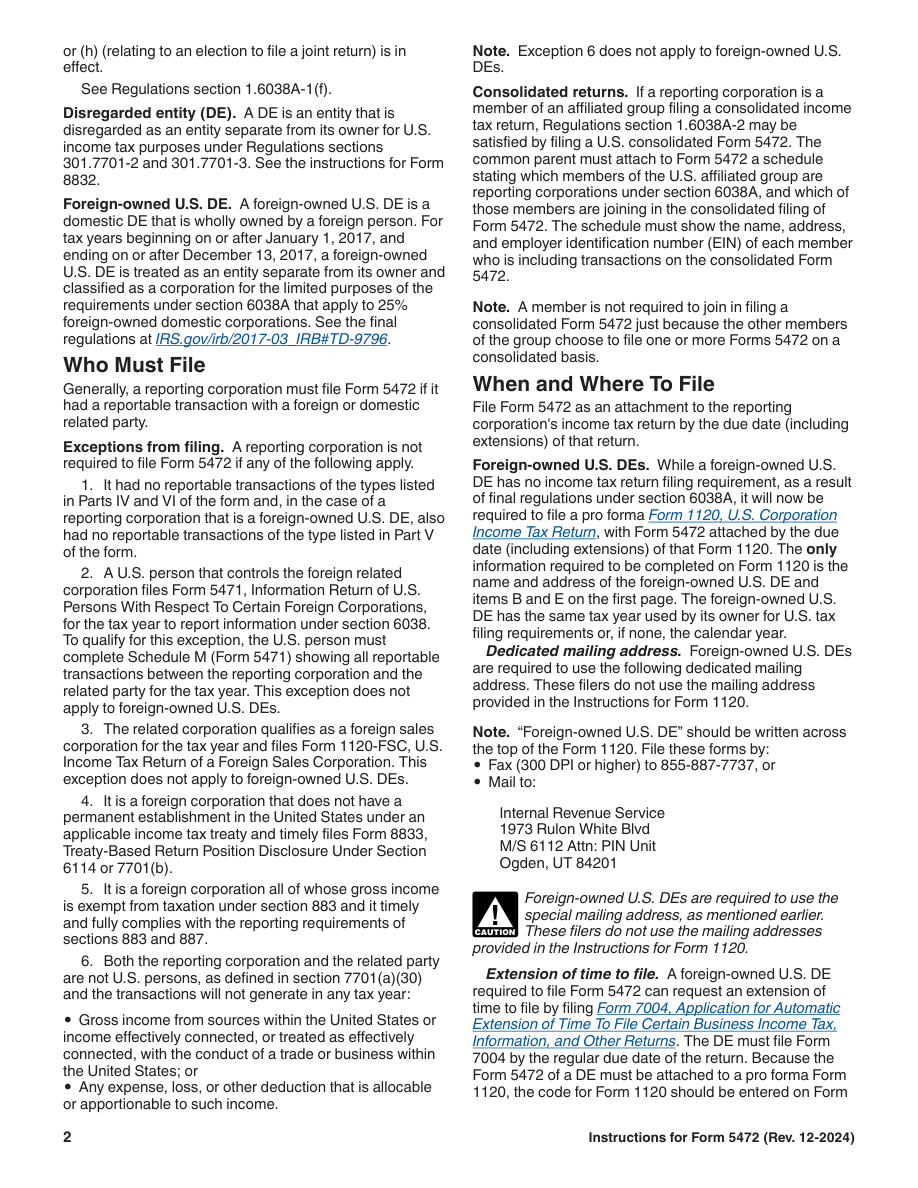
Form 5472's reporting question turns on the applicable reporting corporation and reportable related-party transactions. For a foreign-owned U.S. disregarded entity, the no-transaction exception must also be checked against Part V, including its specified formation and capital-related transactions. No operating revenue is not automatically the same as no relevant transaction. The applicable year and pro forma package rules matter as well. This guide does not declare that every quiet LLC must file or that every company will receive a particular notice. It explains how to ask the filing question using evidence rather than treating the presence or absence of a reminder as the governing rule.[1, p.2]
The official requirements, compared
| Question or field | Official instruction | Conditions and limits | Source |
|---|---|---|---|
| Reportable transaction trigger | A reporting corporation generally files Form 5472 when it has a reportable transaction with a foreign or U.S. related party during the tax year. Operating revenue alone does not determine the filing requirement. | — | [1, p.2] |
| Foreign owned us de definition | A foreign-owned U.S. disregarded entity is a domestic disregarded entity wholly owned by a foreign person. Its treatment as a corporation for these purposes is limited to the reporting requirements related to section 6038A. | — | [1, p.2] |
| De tax year | A foreign-owned U.S. DE uses the tax year its owner uses for U.S. tax filing. If the owner does not have such a tax year, the DE uses a calendar year. | — | [1, p.2] |
| No transaction exception | Check the no-reportable-transaction exception against Parts IV and VI and, for a foreign-owned U.S. DE, Part V. Having no operating revenue is not itself an exception. | — | [1, p.2] |
| Part5 other de transactions | A foreign-owned U.S. DE checks Part V and attaches a description for other specified transactions not reported in Part IV, including receipts and payments connected with formation, dissolution, acquisition, disposition, contributions and distributions. | Foreign-owned U.S. disregarded entity. The relevant transactions have not been reported in Part IV. | [1, p.6] |
| De proforma required | A foreign-owned U.S. DE subject to Form 5472 filing attaches Form 5472 to a pro forma Form 1120 and files by the Form 1120 due date, including a valid extension. | — | [1, p.2] |
Read the requirements in context
Records sufficiency
Keep permanent books and records sufficient to establish the correctness of the federal return and the treatment of related-party transactions, together with the detailed requirements of Regulations section 1.6038A-3.[1, p.3]
Failure penalty
Failure to file Form 5472 at the prescribed time and in the prescribed manner, or to maintain required records, can result in a $25,000 penalty. A substantially incomplete form is treated as a failure to file.[1, p.3]
A worked preparation example
This example is hypothetical; it shows how to organize the facts, not an agency decision.
Consider a hypothetical owner, Mina, whose LLC has no customer sales during a start-up year. She has not received an annual reminder and sees no active filing task in her own planning list. Instead of concluding that nothing is due, Mina opens the underlying records. She identifies the entity and its classification, establishes the applicable year and lists payments or receipts involving the owner or other related parties. Formation-related payments and funding are reviewed under the relevant instructions rather than disappearing because sales were zero. If she believes an exception applies, the sheet states the facts that support that view and the conditions still needing confirmation. She also checks whether anyone previously prepared or submitted a package, since no reminder does not answer that historical question either. The result may be a supported filing request or a focused question for appropriate review; the example does not decide Mina's actual obligation from the start-up label alone. Its value is that work begins from identifiable facts and documents, not from an assumption that a quiet inbox has made a tax determination.[1, p.2]
Turn the records into a usable filing plan
Schedule an owner review of the records relevant to the applicable period, and keep the review separate from a provider's messaging or task status. Document what was examined and which questions remain. If SpeedEIN's supported annual or late-filing service is relevant, provide those facts before preparation and confirm the actual work requested. Do not assume that ordering an EIN establishes an ongoing comprehensive compliance service or that a reminder includes every possible obligation. A clear self-review can identify the next action without inventing a new requirement or relying on silence as proof. Preserve the conclusion and its supporting facts so the same uncertainty is not repeated at the next handoff.[1, p.2]
Three checks before you proceed
- What actual entity, year and transaction facts support the filing assessment?
- If an exception is proposed, have all its applicable transaction categories been checked?
- Is the conclusion based on records rather than the absence of a reminder or a service task?
Related preparation guides
- Personal and LLC Transactions Share a Statement: Build a Reviewable Separation Ledger
- Owner-Paid Bills Before the LLC Bank Account Opened: Reconstruct the Funding Trail
- No Revenue Is Not the Same as No Reportable Owner Transactions
Official sources and document versions
Official source versions checked: 2026-11-10
- Instructions for Form 5472 (Rev. December 2024) — Rev. December 2024
Get help with the relevant SpeedEIN service
SpeedEIN provides preparation and support within the scope described on its service pages. Review the supported entity types, required information and current service scope before ordering. IRS decisions, processing and any applicable filing or payment obligations remain governed by the official rules.