The LLC Changed Owners During the Year: Build a Reporting-Period and Counterparty Timeline
· 6 min read
The answer for this situation
An ownership change calls for a dated ownership and counterparty timeline before the annual preparation file is treated as one uninterrupted owner record. Start by separating the date a change was discussed, the date the available records say it became effective and the dates of the transactions being reviewed. Then identify the actual party connected with each event. The timeline should make uncertainty visible, especially when a payment description says only owner contribution and does not identify which person was involved. It does not itself decide the LLC's classification, reporting year or need for another EIN. Its purpose is to produce clear questions about the relevant periods and relationships, so the later preparation work is based on the entity's documented history rather than on whoever currently answers its emails.[1, p.1] [2, p.4] [2, p.3] [2, p.6]
Which facts change the answer?
This method is limited to organizing the reporting-year and related-party information identified in the cited material. A foreign-owned DE's tax-year rule needs to be considered using the owner's relevant U.S. tax-filing year, with the stated calendar-year rule where applicable. An ownership event does not automatically create a new reporting period or settle how a particular transaction should be reported. A change that affects the entity's classification, owner type or supported service facts may require review outside a standard annual package. Keep that scope issue separate from the factual exercise of placing documents and transactions on a timeline.[1, p.1] [2, p.4] [2, p.3] [2, p.6]
The official requirements, compared
| Question or field | Official instruction | Conditions and limits | Source |
|---|---|---|---|
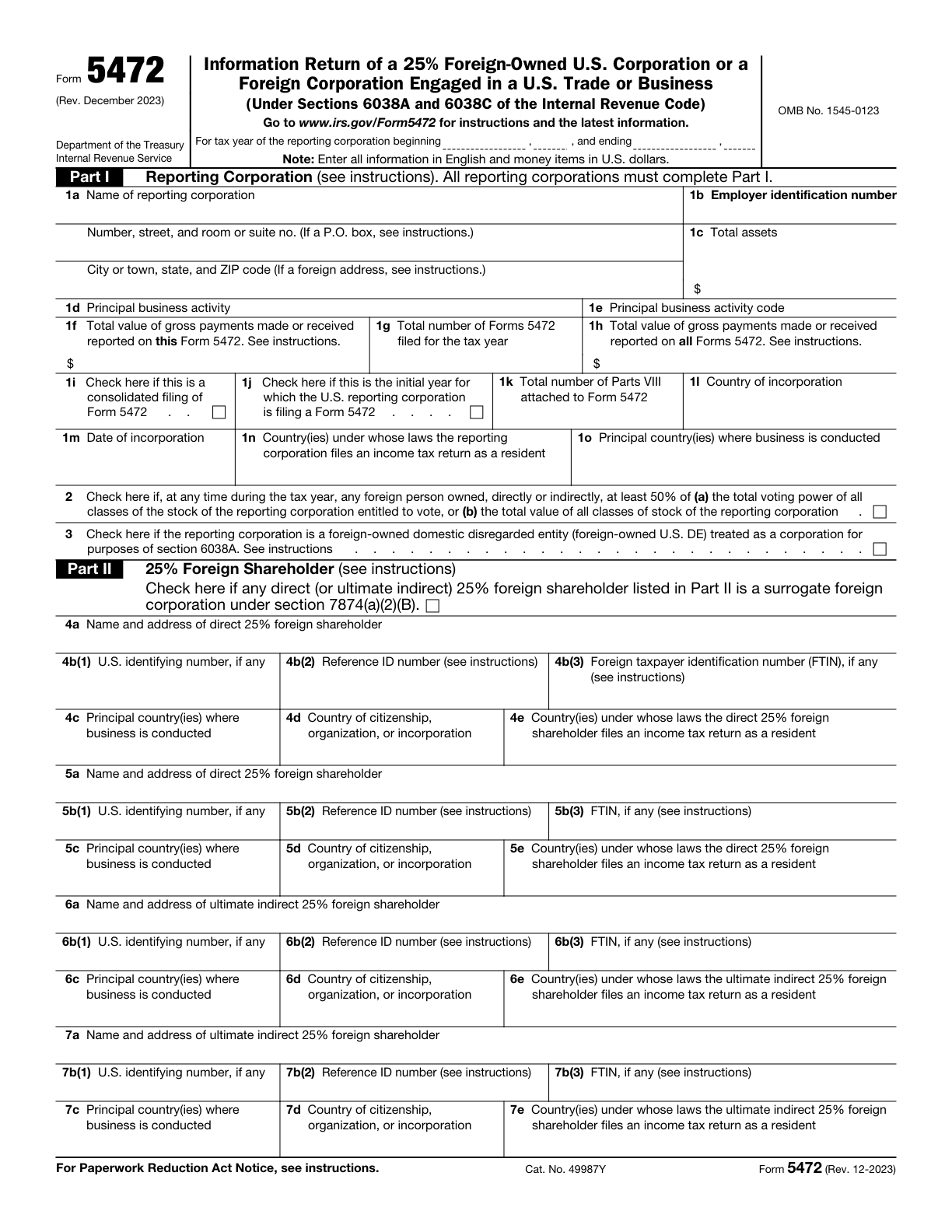
| Official field 5472 4a: Name and address of direct 25% foreign shareholder | Enter the name and address of the largest direct 25% foreign shareholder. A foreign-owned U.S. DE reports its foreign owner in the shareholder fields as instructed. | — | [1, p.1] [2, p.4] |
| Separate related party form | Prepare a separate Form 5472 for each foreign or U.S. related party with which the reporting corporation had reportable transactions. Item 1g is the total number of Forms 5472 for that tax year. | — | [2, p.3] |
| Part5 other de transactions | A foreign-owned U.S. DE checks Part V and attaches a description for other specified transactions not reported in Part IV, including receipts and payments connected with formation, dissolution, acquisition, disposition, contributions and distributions. | Foreign-owned U.S. disregarded entity. The relevant transactions have not been reported in Part IV. | [2, p.6] |
| Related party repeat part3 | Every filer completes Part III, even when that related party was already identified in Part II as a 25% foreign shareholder. | — | [2, p.5] |
| De tax year | A foreign-owned U.S. DE uses the tax year its owner uses for U.S. tax filing. If the owner does not have such a tax year, the DE uses a calendar year. | — | [2, p.2] |
| Reportable transaction trigger | A reporting corporation generally files Form 5472 when it has a reportable transaction with a foreign or U.S. related party during the tax year. Operating revenue alone does not determine the filing requirement. | — | [2, p.2] |
Read the requirements in context
Records sufficiency
Keep permanent books and records sufficient to establish the correctness of the federal return and the treatment of related-party transactions, together with the detailed requirements of Regulations section 1.6038A-3.[2, p.3]
Official field 5472 6a: Name and address of ultimate indirect 25% foreign shareholder
Enter the name and address of the largest ultimate indirect 25% foreign shareholder. A foreign-owned U.S. DE reports its foreign owner in the shareholder fields as instructed.[1, p.1] [2, p.4]
When this applies: Complete a shareholder group only when the corresponding direct or ultimate indirect 25% foreign-shareholder category, number of shareholders and requested information actually apply. Do not repeat a sole owner automatically in every group.
Previous ein disclosure
Line 18 asks whether the applicant previously received an EIN. If Yes, enter that prior EIN.[3, p.1]
A worked preparation example
This example is hypothetical; it shows how to organize the facts, not an agency decision.
Imagine a hypothetical LLC whose original owner transfers the interest to another person during the year. The folder contains an agreement, messages discussing the handover, several bank entries labelled owner funds and the existing EIN record. The preparer creates one timeline for the ownership information and a second linked list for the transactions. Each ownership entry shows its document reference and whether its effective date is established or still disputed. Each bank entry shows the named sender or recipient where known; a generic owner label is not silently assigned to the person who owns the LLC at year end. The preparer then marks which reporting-period facts need confirmation before arranging the records for Form 5472. Formation, acquisition, disposition, contribution or distribution descriptions are considered with their applicable conditions, including whether transactions have already been reported in Part IV. The existing EIN is kept in the entity history rather than replaced in the worksheet to simplify the handover. This hypothetical exercise delivers a dated set of facts and unresolved questions. It does not conclude that a new EIN is required, that two returns are automatically due or that the ownership change fits the standard service's accepted facts.[1, p.1] [2, p.4] [2, p.3] [2, p.6]
Turn the records into a usable filing plan
Use the timeline to conduct a targeted reconciliation with the current owner and the people holding the earlier records. Ask for clarification of a specific date or counterparty, not a general assurance that everything transferred correctly. Keep a distinction between a correction to an old description and an event that actually changed ownership. Once the facts are sufficiently established, the applicable reporting-period and transaction rules can be reviewed without using one year-end snapshot to represent the whole year. Retain source records and the explanation of any unresolved entry; a newly formatted spreadsheet does not replace the records supporting the eventual treatment. Before asking SpeedEIN to prepare an annual package, disclose the ownership change and any entity-owner or classification questions. The service's ordinary individual-owner DE scope should not be assumed to cover an unusual handover or a broader corporate return simply because the LLC name stayed the same.[1, p.1] [2, p.4] [2, p.3] [2, p.6]
Three checks before you proceed
- Which document supports the ownership-effective date, and how does it differ from discussion or payment dates?
- Can each relevant transaction be linked to its actual counterparty and reporting-period question rather than to a generic owner label?
- Do the ownership facts create classification, tax-year or service-scope questions that remain unresolved before preparation?
Related preparation guides
- Personal and LLC Transactions Share a Statement: Build a Reviewable Separation Ledger
- Owner-Paid Bills Before the LLC Bank Account Opened: Reconstruct the Funding Trail
- An LLC Ownership Change Needs a New-EIN Review, Not an Automatic Repeat Application
Official sources and document versions
Official source versions checked: 2026-11-10
- Form 5472 (Rev. December 2023) — Rev. December 2023
- Instructions for Form 5472 (Rev. December 2024) — Rev. December 2024
- Form SS-4 (Rev. December 2025) — Rev. December 2025
Get help with the relevant SpeedEIN service
SpeedEIN provides preparation and support within the scope described on its service pages. Review the supported entity types, required information and current service scope before ordering. IRS decisions, processing and any applicable filing or payment obligations remain governed by the official rules.