Not Every Form 5472 Field Applies to a Foreign-Owned DE: Build an Applicability Map
· 6 min read
The answer for this situation
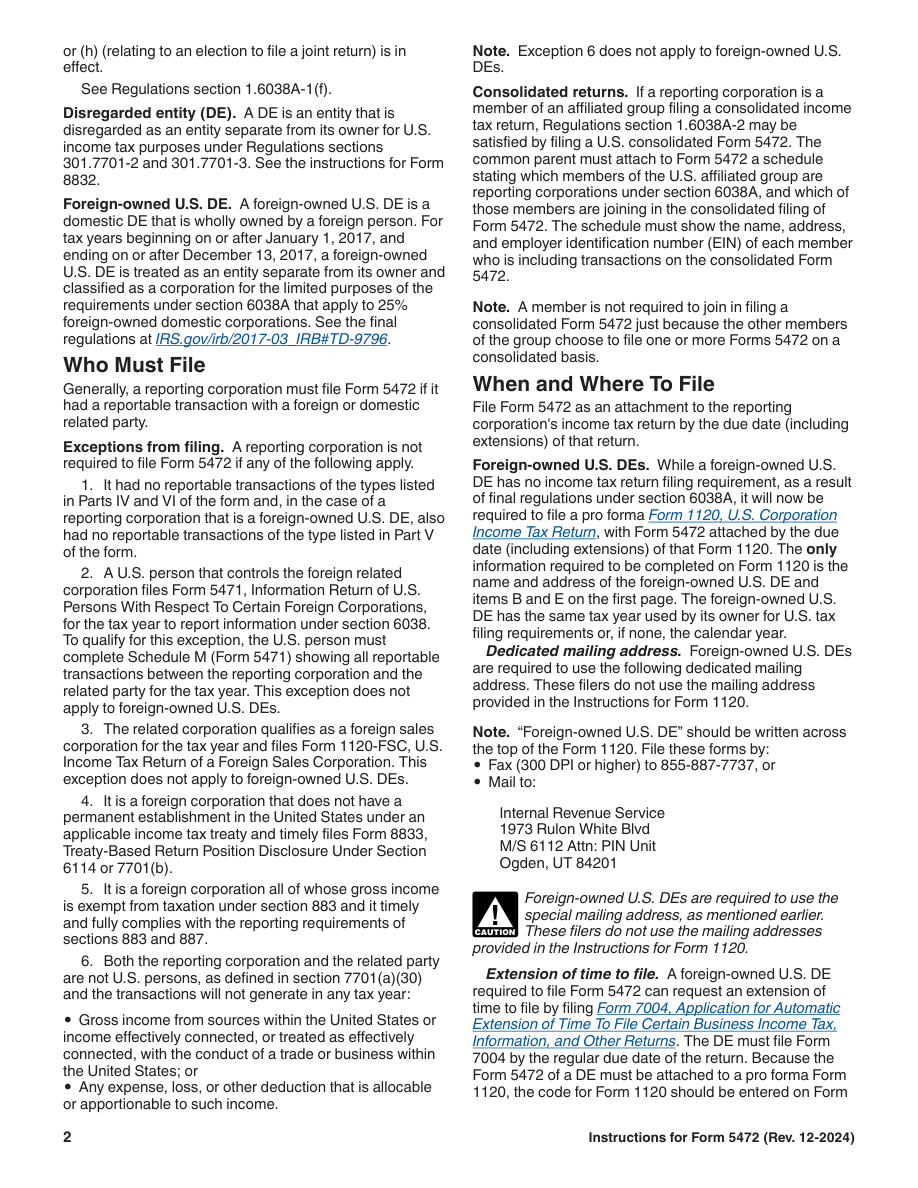
A useful Form 5472 applicability map starts with the entity's actual classification, then asks which instructions govern each part of the packet. It should not start by treating every visible box as a question that must receive an answer. For a foreign-owned U.S. disregarded entity, the special reporting treatment does not automatically turn the entity into an ordinary corporation filing a complete corporate income-tax return. Create a working grid with a field or section, its applicable instruction, the facts supporting the decision and the intended preparation action. Keep an unresolved category as well: uncertainty is a reason to obtain a supported answer, rather than to select whichever response makes the software continue. The resulting grid makes an excluded field distinguishable from an overlooked field, without inventing a new exemption.[1, p.2] [1, p.7]
Which facts change the answer?
This method concerns the foreign-owned U.S. DE reporting context described in the cited instructions. It is not a guide to completing all fields for ordinary domestic corporations or to analyzing covered debt instruments. The pro forma Form 1120 directions and the expressly excluded Form 5472 debt-instrument lines belong in separate rows because they address different documents and different limits. A preparation map is an editorial aid, not an additional IRS form. For signature and authorization, check the current instructions for the document being prepared rather than deriving a separate rule from the limited pro forma information list.[1, p.2] [1, p.7]
The official requirements, compared
| Question or field | Official instruction | Conditions and limits | Source |
|---|---|---|---|
| Foreign owned us de definition | A foreign-owned U.S. disregarded entity is a domestic disregarded entity wholly owned by a foreign person. Its treatment as a corporation for these purposes is limited to the reporting requirements related to section 6038A. | — | [1, p.2] |
| Line43 de excluded | Lines 43a and 43b apply only to domestic corporations within the instructions' definition. A foreign-owned U.S. DE does not complete those lines. | Foreign-owned U.S. disregarded entity. | [1, p.7] |
| Proforma only fields | The special pro forma Form 1120 instructions for a foreign-owned U.S. DE require its name and address and items B and E on the first page. Do not automatically expand this into the full income-tax return for an ordinary C corporation. | — | [1, p.2] |
| Part5 other de transactions | A foreign-owned U.S. DE checks Part V and attaches a description for other specified transactions not reported in Part IV, including receipts and payments connected with formation, dissolution, acquisition, disposition, contributions and distributions. | Foreign-owned U.S. disregarded entity. The relevant transactions have not been reported in Part IV. | [1, p.6] |
| Part6 attachment | For Part VI, attach the required description of nonmonetary or less-than-full-consideration transactions. Do not complete this Part for transactions with a domestic related party. | — | [1, p.6] |
| Official field 5472 3: the reporting corporation is a foreign-owned domestic disregarded entity | Check this if the reporting corporation is a foreign-owned U.S. DE. | — | [2, p.1] [1, p.4] |
Read the requirements in context
Official field 5472 43a: Did the reporting corporation issue a covered debt instrument
Only an applicable domestic corporation answers under the covered-debt-instrument rules. A foreign-owned U.S. DE does not complete line 43.[2, p.3] [1, p.7]
Official field 5472 43b(1): The amount of such transaction(s), distribution(s), and acquisition(s)
When line 43a applies and is Yes, determine the transaction, distribution and acquisition amount as instructed. A foreign-owned U.S. DE does not complete this field.[2, p.3] [1, p.7]
Official field 5472 43b(2): The amount of such related party indebtedness
When line 43a applies and is Yes, enter the related-party indebtedness amount as instructed. A foreign-owned U.S. DE does not complete this field.[2, p.3] [1, p.7]
A worked preparation example
This example is hypothetical; it shows how to organize the facts, not an agency decision.
Consider a hypothetical owner who downloads a full corporate tax organizer after forming a single-member LLC. The organizer asks for answers to every Form 5472 section, including the covered-debt-instrument lines, and presents a complete Form 1120 income schedule. Instead of supplying convenient zeros, the owner first labels the organizer as a commercial questionnaire and checks the official instructions for the actual entity. The owner creates one row for the DE identification box, another for the limited pro forma information, and a separate group for transaction sections. The debt-instrument rows receive a reference to the explicit DE exclusion; they are not marked as unanswered research about the owner's loan balance. Next, the owner lists a formation payment and a contribution as items needing transaction review, without deciding from their filenames which part applies. The Part V row retains the condition that the relevant transactions were not already reported in Part IV. A possible nonmonetary arrangement receives its own Part VI review, including the domestic-related-party limitation. The output is a field applicability record with different reasons for different actions, rather than a completed return or an assertion that every remaining field is irrelevant.[1, p.2] [1, p.7]
Turn the records into a usable filing plan
Keep the map beside the working forms and give each decision a precise status, such as expressly excluded for this entity, applicable subject to the recorded facts, or unresolved. A blank box on a draft should therefore have a reason in the working notes, even when those notes are not themselves submitted. Before using an automated organizer, compare its questions with the map so its defaults do not silently broaden the filing. Preserve the distinction between a supporting internal note and an attachment that the government instructions actually require. If the facts instead point to an ordinary corporate return or a specialized debt analysis, stop using a standard DE checklist as a substitute. SpeedEIN's ordinary annual service should be considered only within its stated supported ownership and entity scope; an applicability question does not expand that scope or promise a government outcome.[1, p.2] [1, p.7]
Three checks before you proceed
- Which entity classification and official instruction support each applicable or excluded field?
- Have the Part V and Part VI conditions been assessed separately rather than copied from a generic corporate organizer?
- Have the current instructions for each document's signature and applicable authorization been checked without inferring a rule from the limited pro forma information list?
Related preparation guides
- A U.S. Related Party and a Foreign Related Party: Why the Form 5472 Entries Differ
- The LLC Changed Owners During the Year: Build a Reporting-Period and Counterparty Timeline
- Before Preparing Form 5472: Confirm U.S. Formation, Foreign Ownership, and DE Status
Official sources and document versions
Official source versions checked: 2026-11-10
- Instructions for Form 5472 (Rev. December 2024) — Rev. December 2024
- Form 5472 (Rev. December 2023) — Rev. December 2023
Get help with the relevant SpeedEIN service
SpeedEIN provides preparation and support within the scope described on its service pages. Review the supported entity types, required information and current service scope before ordering. IRS decisions, processing and any applicable filing or payment obligations remain governed by the official rules.