Spouses Own the LLC: Check the Community-Property Instruction Before Counting Members
· 6 min read
The answer for this situation
Marriage does not make an LLC member-count question self-answering. The SS-4 instructions contain a specific community-property treatment under which qualifying spouses may enter 1 as directed, but that is a conditional instruction rather than a rule for every married couple. Build a spouse-ownership verification sheet before choosing the entry. It should show the applicant, the ownership described by its records, the relevant property-law question and the basis for the proposed treatment. This creates a useful decision file even when the answer still needs specialized review. It also prevents a simplified service designed for one individual from being assumed to cover a joint ownership arrangement merely because the owners are married or share an address.[1, p.3] [2, p.1]
Which facts change the answer?
Keep three questions separate: how the LLC was organized, who owns it and whether the particular spouse instruction applies. A domestic eligible entity generally defaults to partnership classification with two or more members and disregarded classification with a single owner, subject to the applicable rules and elections. The LLC's place of organization is not determined by its members' nationality. Do not infer the relevant property-law conclusion from a mailing address, a wedding certificate or the state name on the formation document alone. The worksheet records the question and supporting material; it does not supply an unverified list of qualifying jurisdictions.[1, p.3] [2, p.1]
The official requirements, compared
| Question or field | Official instruction | Conditions and limits | Source |
|---|---|---|---|
| Member count | If line 8a is Yes, enter the number of LLC members on line 8b. Spouses meeting the community-property conditions in the instructions may enter 1 as directed. | — | [1, p.3] |
| Default classification | A domestic single-member LLC generally defaults to an entity disregarded as separate from its owner; a domestic LLC with two or more members generally defaults to partnership classification. | — | [1, p.3] |
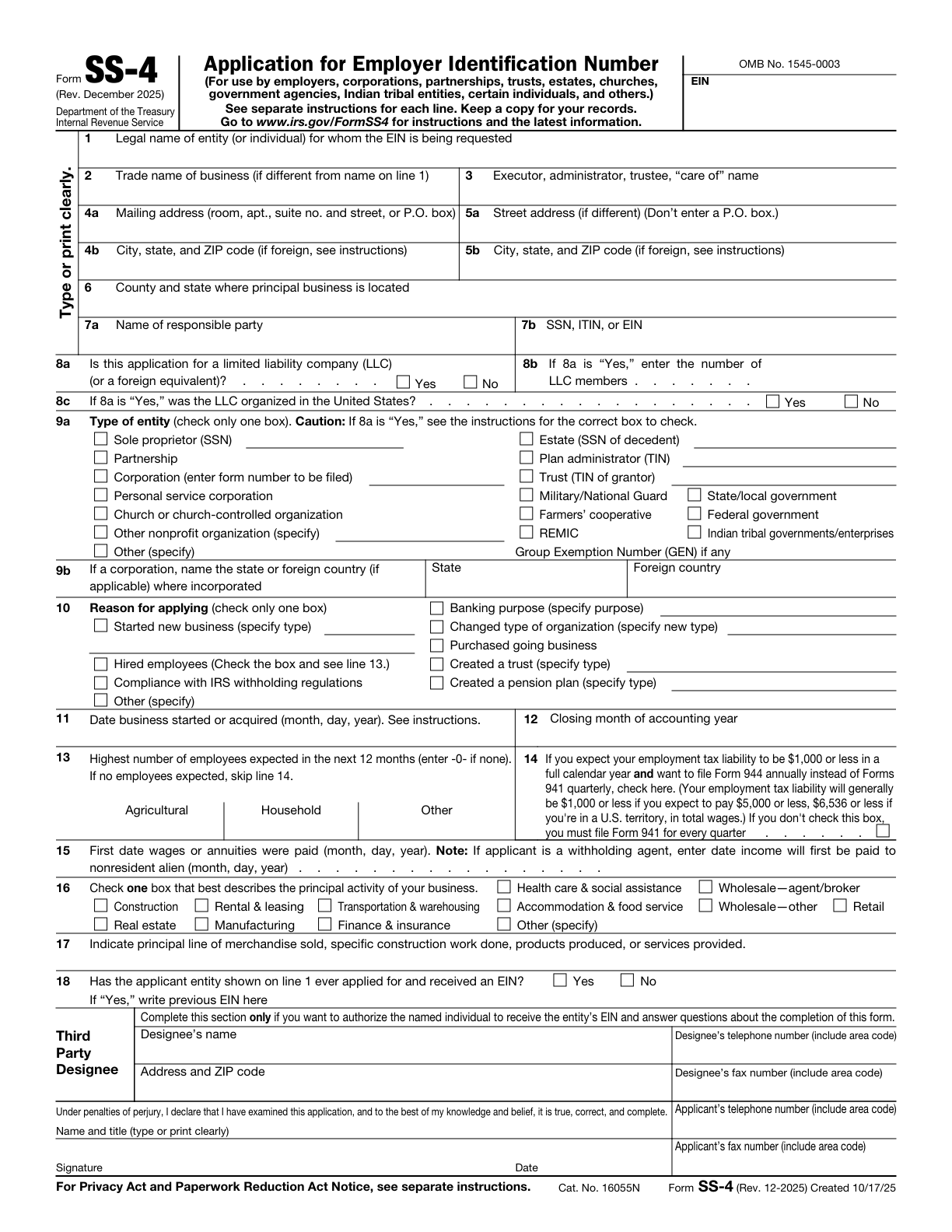
| Official field SS-4 8b: If 8a is “Yes,” enter the number of LLC members | If line 8a is Yes, enter the member count. Apply the special spouse rule separately where relevant. | — | [2, p.1] [1, p.3] |
| Domestic default | Without an election, a domestic eligible entity with two or more members generally defaults to a partnership; one with a single owner generally defaults to a disregarded entity. | — | [3, p.5] |
| Foreign owned us de definition | A foreign-owned U.S. disregarded entity is a domestic disregarded entity wholly owned by a foreign person. Its treatment as a corporation for these purposes is limited to the reporting requirements related to section 6038A. | — | [4, p.2] |
| Official field SS-4 8a: Is this application for a limited liability company (LLC) (or a foreign equivalent)? | Answer whether the applicant is an LLC or a similar foreign entity. | — | [2, p.1] [1, p.3] |
Read the requirements in context
Official field SS-4 8c: If 8a is “Yes,” was the LLC organized in the United States?
Answer according to where the LLC was organized, rather than its members' nationality.[2, p.1]
Responsible party individual
Except for the government-entity exception, the responsible party must be an individual rather than another entity.[1, p.3]
Limits to keep: Government entities follow the EIN exception in the instructions.
Official field 8832 3: Does the eligible entity have more than one owner?
Answer using the actual number of owners and follow the Yes/No directions to line 5 or 4. The available classifications depend on the owner count.[3, p.2]
Consent signatures
Obtain the Form 8832 consent signatures required from applicable members or owners, or an appropriately authorized person. A retroactive effective period can require consent from former owners as well.[3, p.7]
A worked preparation example
This example is hypothetical; it shows how to organize the facts, not an agency decision.
Suppose a married couple's LLC records show interests held by both spouses. Before preparing the SS-4 member-count answer, they list what those records say and identify the community-property issue that needs checking. One column contains the proposed answer; another contains the specific instruction and the evidence supporting its applicability. If that evidence is incomplete, the proposed count remains under review rather than being changed to 1 because the couple considers the business a family operation. They separately record where the LLC was organized and who should be identified as the individual responsible party. If a classification election is being discussed, they preserve the actual owner information for that separate analysis instead of treating the SS-4 count as an election. The file also records whether the service under consideration supports this ownership pattern. This hypothetical produces a question that can be reviewed against the relevant rules: why is the special spouse instruction applicable here? It does not invent a favorable IRS response, determine local property rights or promise that a standard single-individual filing product is suitable.[1, p.3] [2, p.1]
Turn the records into a usable filing plan
Write a short decision note explaining what has been established and what has not. A useful note distinguishes the documented ownership, the applicable-law issue and any existing tax-classification election. If the conditional spouse instruction is supported, preserve the reason for applying it; if it is not yet supported, retain the uncertainty rather than hiding it in a numeric field. For a possible Form 8832 election, consent requirements are a separate matter and may include former owners when a retroactive effective period is involved. Do not borrow an SS-4 entry to bypass that review. When asking about EIN assistance, describe the actual joint ownership and request confirmation of service scope. The preparation sheet is valuable because it makes the limit of the current conclusion visible, not because it converts a complex arrangement into a simpler one by changing a box.[1, p.3] [2, p.1]
Three checks before you proceed
- What specific facts and applicable-law support justify using the conditional community-property spouse instruction?
- Are member count, responsible-party identity and the LLC's place of organization recorded independently?
- Have any election-consent questions and the service's supported owner types been checked without assuming a single-individual package applies?
Related preparation guides
- A Foreign Company Owns the LLC: Identify the Individual Responsible Party
- A Foreign Parent and a U.S. LLC: Which Entity Is Applying for the EIN?
- SS-4 Lines 7 and 8: Keep the Responsible Party Separate From LLC Ownership Data
Official sources and document versions
Official source versions checked: 2026-11-10
- Instructions for Form SS-4 (Rev. December 2025) — Rev. December 2025
- Form SS-4 (Rev. December 2025) — Rev. December 2025
- Form 8832 (Rev. December 2013) — Rev. December 2013
- Instructions for Form 5472 (Rev. December 2024) — Rev. December 2024
Get help with the relevant SpeedEIN service
SpeedEIN provides preparation and support within the scope described on its service pages. Review the supported entity types, required information and current service scope before ordering. IRS decisions, processing and any applicable filing or payment obligations remain governed by the official rules.