A Foreign Parent and a U.S. LLC: Which Entity Is Applying for the EIN?
· 5 min read
The answer for this situation
A group may speak of the business as one operation while its documents identify more than one legal entity. That becomes a practical problem when an EIN is requested for a U.S. LLC owned by a foreign company. The parent's formation certificate, existing tax numbers and business address can be useful references, but they do not automatically describe the applicant named on line 1. Start with an applicant chart showing the parent, the subsidiary and the person whose control is relevant to the responsible-party question. Its purpose is to stop an identity error before it spreads through every field and into later company records.[1, p.2] [2, p.1] [1, p.3]
Which facts change the answer?
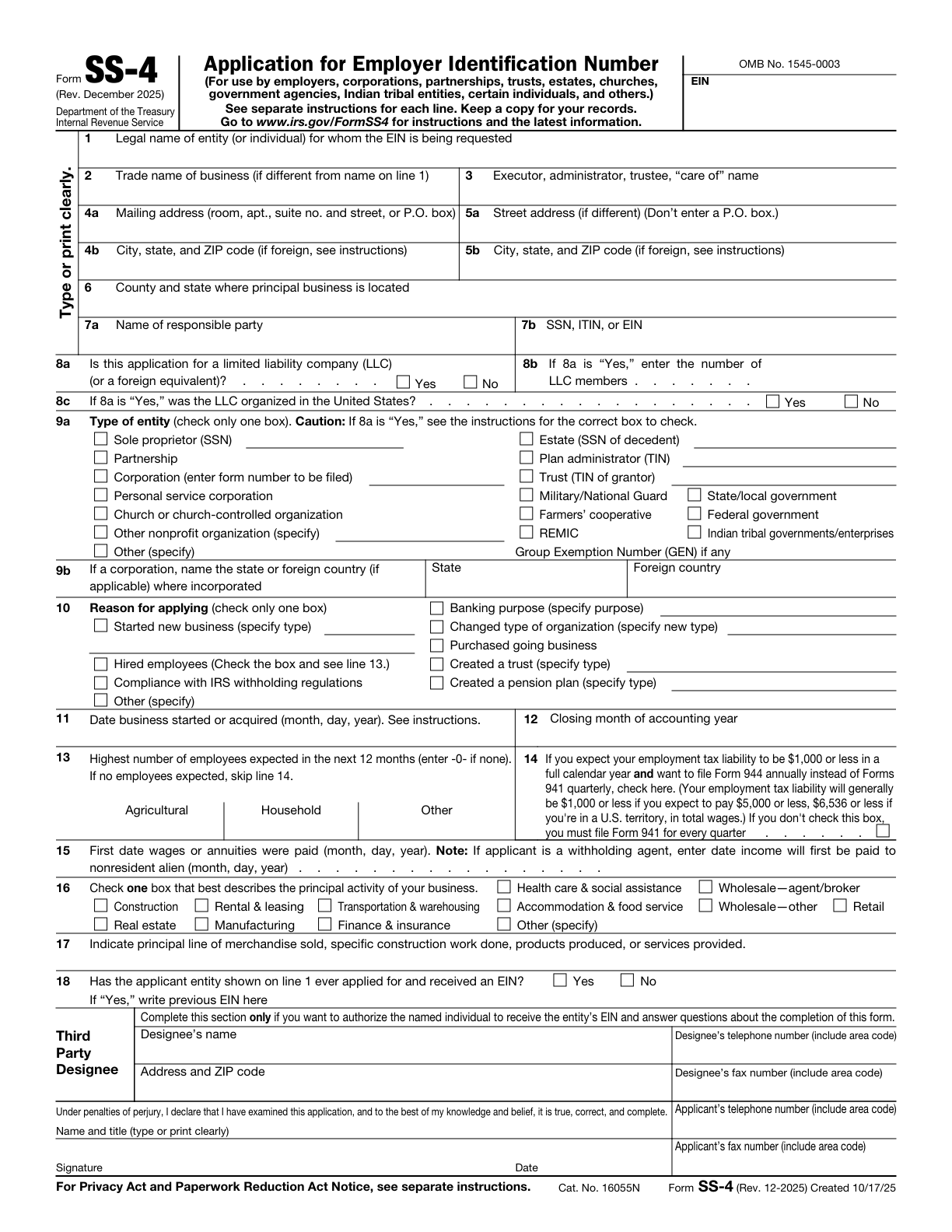
SS-4 asks for the applicant's legal name, LLC membership facts and the relevant formation information. A U.S.-formed LLC does not become foreign-formed merely because its owner is a foreign company. Except for the stated government-entity exception, the responsible party is an individual, not another entity. These are separate questions: who owns the applicant, where the applicant was formed and which individual is identified under the responsible-party rules. A prior EIN question also concerns the applicant entity. This guide does not decide every corporate-chain control issue or present a corporate-owned LLC as eligible for SpeedEIN's simplified annual package for a nonresident individual owner.[1, p.2] [2, p.1] [1, p.3]
The official requirements, compared
| Question or field | Official instruction | Conditions and limits | Source |
|---|---|---|---|
| Legal name | Line 1 requires the applicant's legal name, consistent with the applicable Social Security card, formation document or other legal document. | — | [1, p.2] |
| Official field SS-4 8c: If 8a is “Yes,” was the LLC organized in the United States? | Answer according to where the LLC was organized, rather than its members' nationality. | — | [2, p.1] |
| Member count | If line 8a is Yes, enter the number of LLC members on line 8b. Spouses meeting the community-property conditions in the instructions may enter 1 as directed. | — | [1, p.3] |
| Form entity before ein | The IRS instructs someone creating a corporation or LLC to form the entity with the state before applying for an EIN. | This does not mean the state filing itself assigns an EIN. | [3] |
| Responsible party individual | Except for the government-entity exception, the responsible party must be an individual rather than another entity. | Government entities follow the EIN exception in the instructions. | [1, p.3] |
| Official field SS-4 9a: Type of entity (check only one box) | Select the single classification called for by the instructions. A foreign-owned U.S. disregarded entity applying for Form 5472 purposes follows the special Other description. | — | [2, p.1] [1, p.5] |
Read the requirements in context
Previous ein disclosure
Line 18 asks whether the applicant previously received an EIN. If Yes, enter that prior EIN.[2, p.1]
Foreign owned us de definition
A foreign-owned U.S. disregarded entity is a domestic disregarded entity wholly owned by a foreign person. Its treatment as a corporation for these purposes is limited to the reporting requirements related to section 6038A.[4, p.2]
Default classification
A domestic single-member LLC generally defaults to an entity disregarded as separate from its owner; a domestic LLC with two or more members generally defaults to partnership classification.[1, p.3]
A worked preparation example
This example is hypothetical; it shows how to organize the facts, not an agency decision.
Suppose a hypothetical foreign company, Olive Harbor Ltd, establishes a U.S. LLC called Olive Harbor Commerce LLC. The office coordinator has the parent's papers readily available and begins a new application draft by copying its company-details page. A review shows that line 1 now carries the parent's name while another answer refers to the U.S. LLC. The coordinator stops before trying to make the mixed draft consistent. A chart identifies each entity, its formation document, its own existing identifiers and the exact task being requested. The LLC's formation record supplies the applicant identity where appropriate; the parent's ownership records support a different part of the file. The responsible-party inquiry then identifies the relevant natural person under the instructions rather than entering the parent company simply because it owns the LLC. Existing numbers are labelled by entity so that the parent's number is not presented as an EIN previously assigned to the applicant without checking that fact. The chart also makes the corporate-owner structure visible for any later service eligibility review. The example illustrates a consistency check, not a conclusion that every group has the same controlling individual or that every foreign parent and subsidiary must follow one universal application pattern.[1, p.2] [2, p.1] [1, p.3]
Turn the records into a usable filing plan
Use a separate row for each legal entity whenever documents from a group are supplied. Include the source for the name, formation country and existing identifier, and record which row is the applicant. Ask for clarification if one answer describes the parent and another describes the subsidiary. Do not force a foreign owner's facts into the applicant's formation fields or convert a company owner into a natural person by merely choosing a signatory. SpeedEIN's EIN preparation should be assessed against the actual entity and supported scope. Later annual reporting and classification work need their own eligibility review, rather than treating a successfully organized application file as approval of every future group-related filing task.[1, p.2] [2, p.1] [1, p.3]
Three checks before you proceed
- Which exact legal entity is the applicant named on the SS-4?
- Do formation and earlier-EIN answers refer to that applicant rather than its parent?
- Has the natural-person responsible-party question been examined separately from corporate ownership?
Related preparation guides
- Moving From an Individual Business to an LLC: Reconcile the Applicant and Earlier EIN
- The IRS Asks About Your LLC's Formation: Prepare a Consistent Reply File
- Foreign Formation Country Versus Foreign Ownership on an EIN Application
Official sources and document versions
Official source versions checked: 2026-11-10
- Instructions for Form SS-4 (Rev. December 2025) — Rev. December 2025
- Form SS-4 (Rev. December 2025) — Rev. December 2025
- Get an employer identification number
- Instructions for Form 5472 (Rev. December 2024) — Rev. December 2024
Get help with the relevant SpeedEIN service
SpeedEIN provides preparation and support within the scope described on its service pages. Review the supported entity types, required information and current service scope before ordering. IRS decisions, processing and any applicable filing or payment obligations remain governed by the official rules.