Applying for an EIN by International Telephone: Prepare the Answers and Signing Authority
· 6 min read
The answer for this situation
A useful international EIN call sheet is more than a phone number. It brings together the entity's identity, the facts needed to answer SS-4 questions and the authority of the person making the contact. The IRS lists telephone, fax and mail routes for applicants whose principal place of business is outside the United States; citizenship alone is not the route-selection test. Start by recording why the international route fits the applicant's actual circumstances, then assemble the answers. That makes a call easier to prepare without suggesting that access to a telephone route guarantees an EIN, a completed interview or a particular processing time. The sheet should also show where an answer is still uncertain. Resolving a missing ownership detail or an unclear prior-application history before contact is a concrete preparation task; filling a blank with a convenient guess only makes the document look ready.[1] [2, p.6]
Which facts change the answer?
For an LLC or corporation, state formation comes before the EIN application. Keep the applicant's legal name, mailing address and responsible-party details available. Except for the government-entity exception, the responsible party must be an individual. A foreign or N/A entry on line 7b is conditional: the responsible party must neither have nor be eligible to obtain an SSN or ITIN. Distinguish the person responsible for the entity from an assistant who assembled its documents. A caller’s familiarity with the paperwork does not itself identify the responsible party or establish signing authority. Record each person’s role and the basis for any authorization alongside the proposed answers, rather than relying on a general description such as agent.[1] [2, p.6]
The official requirements, compared
| Question or field | Official instruction | Conditions and limits | Source |
|---|---|---|---|
| Ein international submission routes | The IRS EIN page gives phone, fax and mail routes for applicants whose principal place of business is outside the United States. | Scope is principal place of business, not citizenship alone; recheck current recipient details before submission. | [1] |
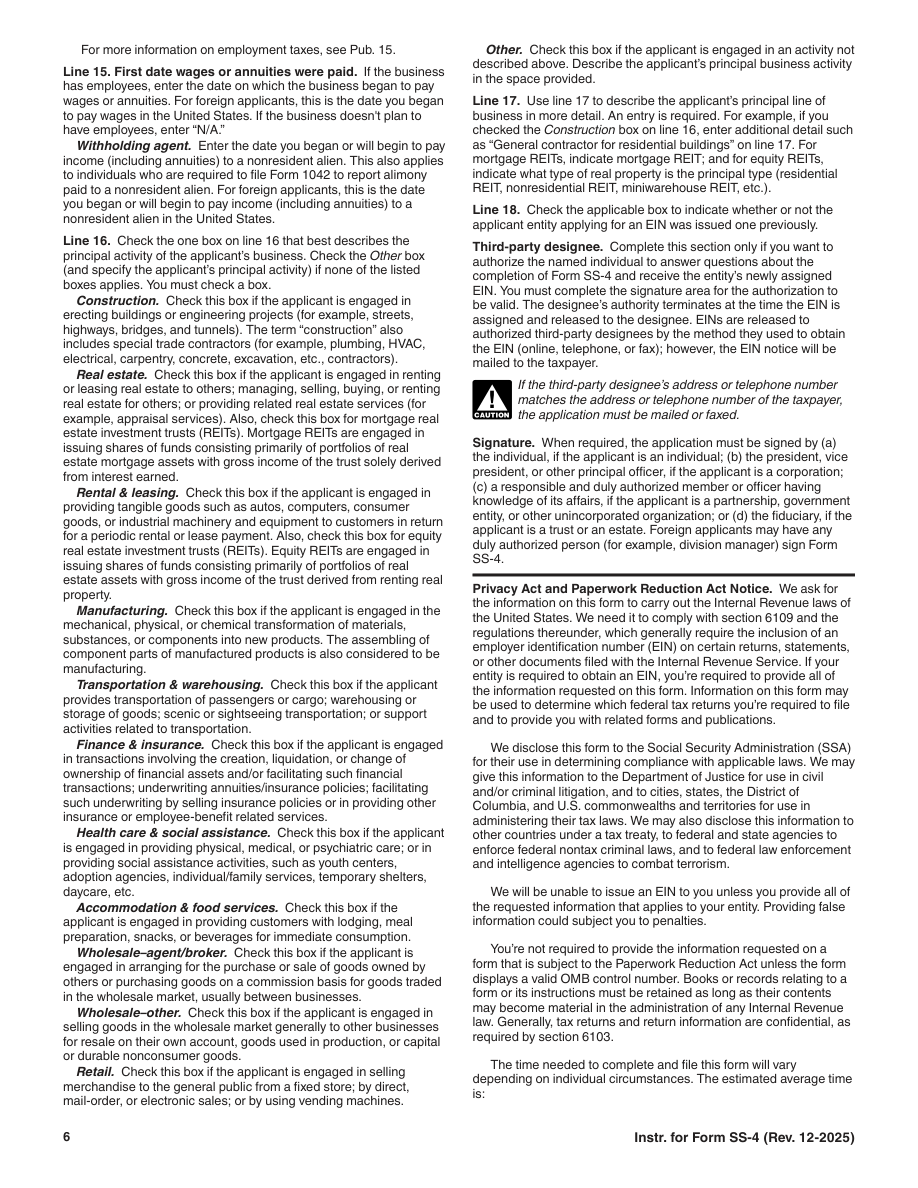
| Authorized signer | The authorized SS-4 signer depends on the type of applicant. A foreign applicant may use a person with appropriate authorization to sign. | — | [2, p.6] |
| Designee scope | The third-party designee may answer questions about the completed SS-4 and receive the new EIN. Signed authorization is required, and that authority ends when the EIN is assigned and released to the designee. | — | [2, p.6] |
| Legal name | Line 1 requires the applicant's legal name, consistent with the applicable Social Security card, formation document or other legal document. | — | [2, p.2] |
| Mailing address | Lines 4a-4b identify the mailing address where the entity receives correspondence. A foreign address must include the city, province or state, postal code and full country name. | — | [2, p.3] |
| Responsible party individual | Except for the government-entity exception, the responsible party must be an individual rather than another entity. | Government entities follow the EIN exception in the instructions. | [2, p.3] |
Read the requirements in context
Id exception
Enter foreign or N/A on line 7b only when the responsible party neither has nor is eligible to obtain an SSN or ITIN. The line must contain an entry.[2, p.3]
When this applies: The responsible party does not have an SSN or ITIN. The responsible party is not eligible to obtain an SSN or ITIN.
Reason required
Select one, and only one, reason for applying on line 10. Do not enter N/A.[2, p.5]
Form entity before ein
The IRS instructs someone creating a corporation or LLC to form the entity with the state before applying for an EIN.[3]
When this applies: This does not mean the state filing itself assigns an EIN.
Official field SS-4 18: Has the applicant entity shown on line 1 ever applied for and received an EIN?
Answer accurately whether this applicant previously received an EIN. If Yes, enter the existing number.[4, p.1] [2, p.6]
A worked preparation example
This example is hypothetical; it shows how to organize the facts, not an agency decision.
Consider an owner preparing for an international telephone application while an assistant gathers the papers. Their call sheet has a source column for each answer: formation document for legal name, correspondence details for the mailing address, and a reasoned identification of the responsible party. They also record whether the applicant previously received an EIN instead of assuming that a new service engagement means a new entity. A separate authorization section identifies who will answer the questions and, where relevant, the signed third-party designation. Before the contact, they check the current official recipient details rather than relying on an old saved number. The example ends with a prepared fact sheet, not a fictional account of an IRS employee approving the application or releasing a number. They organize the sheet in the expected order of the application, with short answers that can be checked against the retained documents. Any longer explanation stays in a supporting note. When an answer changes during preparation, they update the working copy and keep track of the correction so the caller is not relying on an obsolete draft. This is a practical way to make the discussion coherent; it does not claim that the IRS must follow the applicant’s checklist or accept a particular explanation.[1] [2, p.6]
Turn the records into a usable filing plan
Have the completed fact sheet and the applicable signing authority ready for review together. A foreign applicant may use an appropriately authorized signer, but that does not remove the need for a valid third-party designation when that specific authority is used. The designation ends when the new EIN is assigned and released to the designee. SpeedEIN's relevant service page can explain the preparation support it offers; do not infer ongoing IRS representation or guaranteed telephone availability from that support. Treat the call sheet as a record of the facts available before contact, not a script for asserting eligibility that has not been established. Keep a space to record any further information requested and the action actually taken, without pre-filling a successful outcome. If a prior EIN emerges during preparation, return to that identity question instead of treating the international route as permission to request another number. This preserves the difference between choosing a permitted communication route and establishing that the underlying application is appropriate.[1] [2, p.6]
Three checks before you proceed
- Does the applicant's principal place of business support the international route, independently of the owner's nationality?
- Can the caller explain each material SS-4 answer and any prior EIN using the assembled records?
- Are signing authority and any third-party designation valid for the person who will make the contact?
Related preparation guides
- Choosing Self-Preparation or Paid EIN Help: Compare the Work and Responsibility
- The IRS Asks About Your LLC's Formation: Prepare a Consistent Reply File
- Submitting SS-4 by Fax: Preserve the Complete Application and Transmission Record
Official sources and document versions
Official source versions checked: 2026-11-10
- Employer identification number
- Instructions for Form SS-4 (Rev. December 2025) — Rev. December 2025
- Get an employer identification number
- Form SS-4 (Rev. December 2025) — Rev. December 2025
Get help with the relevant SpeedEIN service
SpeedEIN provides preparation and support within the scope described on its service pages. Review the supported entity types, required information and current service scope before ordering. IRS decisions, processing and any applicable filing or payment obligations remain governed by the official rules.