One Disregarded LLC, Different Tax Accounts: Review EIN Use Before Hiring
· 7 min read
The answer for this situation
An LLC described as disregarded can still have entity-level employment-tax questions. Before a hiring plan is turned into another EIN application, prepare a purpose-and-identifier worksheet: what activity is changing, which entity will be involved and what EIN already exists. The SS-4 instructions require a disregarded entity to use its own name and EIN for reporting and payment of employment taxes. They also identify particular excise-tax activities and returns separately. That scoped instruction should not be expanded into a claim that every owner-level income-tax matter uses the same identifier. The worksheet helps keep those questions apart while giving a preparer a coherent account of the new staffing facts, rather than relying on the word disregarded as a complete answer.[1, p.3] [1, p.5] [1, p.6]
Which facts change the answer?
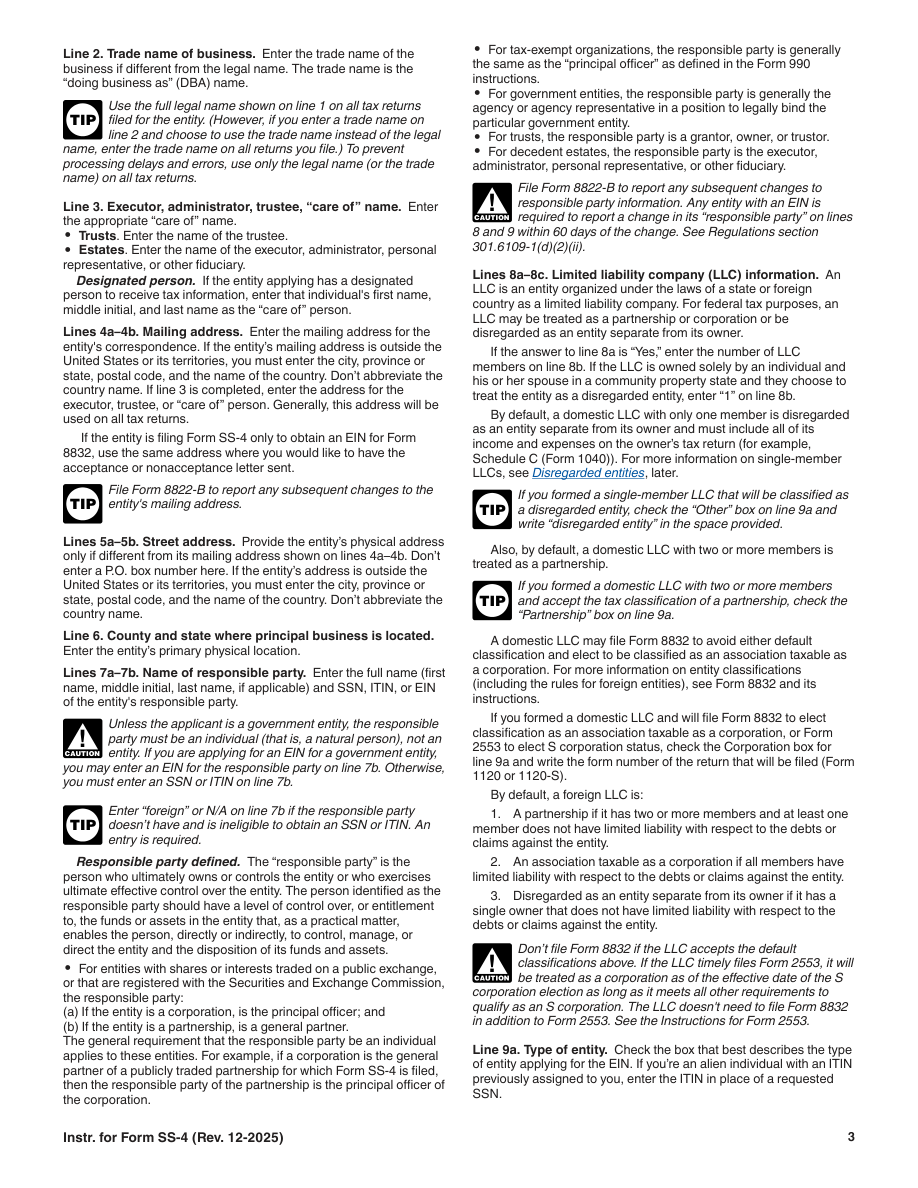
A domestic single-member LLC generally defaults to disregarded treatment, but selecting an entity-type box on SS-4 is not itself a tax-classification election. Employment questions have their own branches. Line 13 asks for the highest expected number in each employee category over the next 12 months, including zero. If no employees are expected, line 14 is skipped; it is not a general checkbox for a no-employee LLC. The ordinary employer instruction for the first wage date is also distinct from the withholding-agent instruction for payments to nonresident aliens. Absence of employees does not eliminate that separate applicable branch.[1, p.3] [1, p.5] [1, p.6]
The official requirements, compared
| Question or field | Official instruction | Conditions and limits | Source |
|---|---|---|---|
| Default classification | A domestic single-member LLC generally defaults to an entity disregarded as separate from its owner; a domestic LLC with two or more members generally defaults to partnership classification. | — | [1, p.3] |
| No employees skip14 | Line 13 asks for the highest expected number of employees in each category during the next 12 months, including zero. Skip line 14 if no employees are expected. | — | [1, p.5] |
| No employees line15 | For the ordinary employer branch, line 15 asks for the first date wages or annuities were paid, with N/A entered if no employees are planned. An applicant acting as a withholding agent follows the separate instruction for the date payments to nonresident aliens begin. | The ordinary employer and withholding-agent branches are separate; having no employees does not eliminate an applicable withholding-agent date requirement. | [1, p.6] |
| Member count | If line 8a is Yes, enter the number of LLC members on line 8b. Spouses meeting the community-property conditions in the instructions may enter 1 as directed. | — | [1, p.3] |
| Responsible party individual | Except for the government-entity exception, the responsible party must be an individual rather than another entity. | Government entities follow the EIN exception in the instructions. | [1, p.3] |
| Not entity election | Checking an entity-type box on SS-4 is not itself an entity-classification tax election. | — | [1, p.4] |
Read the requirements in context
De employment tax own ein
A disregarded entity must use its own name and EIN for reporting and payment of employment taxes. The SS-4 instructions separately identify specified excise-tax activities and returns; this is not a rule that every tax matter uses the same identifier.[1, p.4]
When this applies: The employment-tax statement applies when the disregarded entity reports or pays employment taxes. Apply the instructions for each specifically listed excise-tax activity or return separately.
Limits to keep: Do not infer that every disregarded entity must submit a new EIN application whenever hiring plans change; first establish the entity’s existing EIN and relevant filing facts. This scoped rule does not determine the identifying number for every owner-level income-tax matter.
Official field SS-4 14: If you expect your employment tax liability to be $1,000 or less
If employees are expected, check this box only when eligible and electing annual Form 944 rather than quarterly Form 941 filing. It is not a general box for an applicant without employees.[2, p.1] [1, p.5]
Official field SS-4 15: First date wages or annuities were paid (month, day, year)
Under the ordinary employer branch, enter the first wage or annuity payment date, or N/A if no employees are planned. An applicant acting as a withholding agent separately follows the instruction for when payments to nonresident aliens begin.[2, p.1] [1, p.6]
When this applies: The ordinary employer and withholding-agent branches are distinct; having no employees does not remove an applicable withholding-agent date requirement.
Foreign owned us de definition
A foreign-owned U.S. disregarded entity is a domestic disregarded entity wholly owned by a foreign person. Its treatment as a corporation for these purposes is limited to the reporting requirements related to section 6038A.[3, p.2]
A worked preparation example
This example is hypothetical; it shows how to organize the facts, not an agency decision.
Imagine a single-member LLC that already has an EIN and is preparing for its first planned employee. For this hypothetical, the worker's employee status is a stated fact, not a classification decision made by this guide. The owner assembles the existing EIN record and creates separate worksheet rows for owner-level income-tax identification, LLC employment-tax identification and any other activity needing its own review. The employment row references the LLC's existing name and EIN rather than automatically requesting a new number. A staffing note records the expected headcount by the SS-4 categories and explains the first planned wage date. The owner does not copy an old zero-employee draft simply because it was accurate when the business formed. If any payment activity may involve the withholding-agent branch, that question is highlighted rather than hidden by the employee count. Finally, the preparer marks questions about filing a particular employment return as outside the narrower EIN data-preparation task. The result is a practical account of changed facts and unresolved filing questions, not a claim that the LLC has changed classification or that a payroll filing has been completed.[1, p.3] [1, p.5] [1, p.6]
Turn the records into a usable filing plan
Review the worksheet by purpose before reviewing the numbers. An identifier can be authentic and still be copied into the wrong entity's field. Establish the LLC's existing EIN and the relevant employment facts before deciding whether any new application is needed; a hiring change alone should not be treated as an instruction here to apply again. Preserve the separate questions concerning owner-level income-tax identification instead of trying to solve them by analogy. If Form 944 is being considered, its eligibility and election instructions need their own assessment; it is not the automatic result of having few or no employees. SpeedEIN's relevant EIN service may be considered within its published preparation scope, but this worksheet does not offer payroll filing, determine every worker's status or establish that no other return is required. Its concrete output is a purpose-based identity map that a reviewer can use without guessing what the owner meant by the company's tax account.[1, p.3] [1, p.5] [1, p.6]
Three checks before you proceed
- Does the employment-tax row identify the LLC itself and establish whether it already has an EIN?
- Do employee counts and first-payment facts describe the current plan rather than an obsolete application draft?
- Have owner-level income tax, any applicable withholding-agent branch and actual return preparation remained separate review questions?
Related preparation guides
- Spouses Own the LLC: Check the Community-Property Instruction Before Counting Members
- A Foreign Company Owns the LLC: Identify the Individual Responsible Party
- SS-4 Lines 13–15 When the LLC Has No Employees
Official sources and document versions
Official source versions checked: 2026-11-10
- Instructions for Form SS-4 (Rev. December 2025) — Rev. December 2025
- Form SS-4 (Rev. December 2025) — Rev. December 2025
- Instructions for Form 5472 (Rev. December 2024) — Rev. December 2024
Get help with the relevant SpeedEIN service
SpeedEIN provides preparation and support within the scope described on its service pages. Review the supported entity types, required information and current service scope before ordering. IRS decisions, processing and any applicable filing or payment obligations remain governed by the official rules.