Foreign-Language Records, English Filing Data: Keep a Clear Translation Trail
· 6 min read
The answer for this situation
Foreign-language source records can support English filing information without losing the connection to the originals. Build a three-column translation trail: the original term or passage, the working English description and the form entry or preparation question it supports. Include document and page references so a reviewer can return to the context instead of relying on a detached translated phrase. Form 5472 information is provided in English and amounts in U.S. dollars, but that does not establish a universal rule here about certified translations of every underlying record. The useful output is an auditable working glossary and record map, with uncertain identity or transaction wording marked for review rather than polished into unsupported certainty.[1, p.1] [2, p.3] [1, p.2] [2, p.5]
Which facts change the answer?
Translation and tax characterization are different tasks. An English word chosen for a transfer does not itself determine whether it is a contribution, distribution, payment for services or another transaction. The relevant Part V and related-party conditions still need their own assessment. Preserve party identity and the legal-name information supported by the applicable documents, and keep FTIN or reference-ID instructions tied to their specific fields. Translation of an amount's label is also different from currency conversion: Part IV and VI dollar amounts require the applicable exchange-rate schedule, including the accounting-method qualifications in the instructions. A fluent English worksheet cannot replace those supporting facts.[1, p.1] [2, p.3] [1, p.2] [2, p.5]
The official requirements, compared
| Question or field | Official instruction | Conditions and limits | Source |
|---|---|---|---|
| English usd | Provide Form 5472 information in English and report amounts in U.S. dollars. | — | [1, p.1] |
| Records sufficiency | Keep permanent books and records sufficient to establish the correctness of the federal return and the treatment of related-party transactions, together with the detailed requirements of Regulations section 1.6038A-3. | — | [2, p.3] |
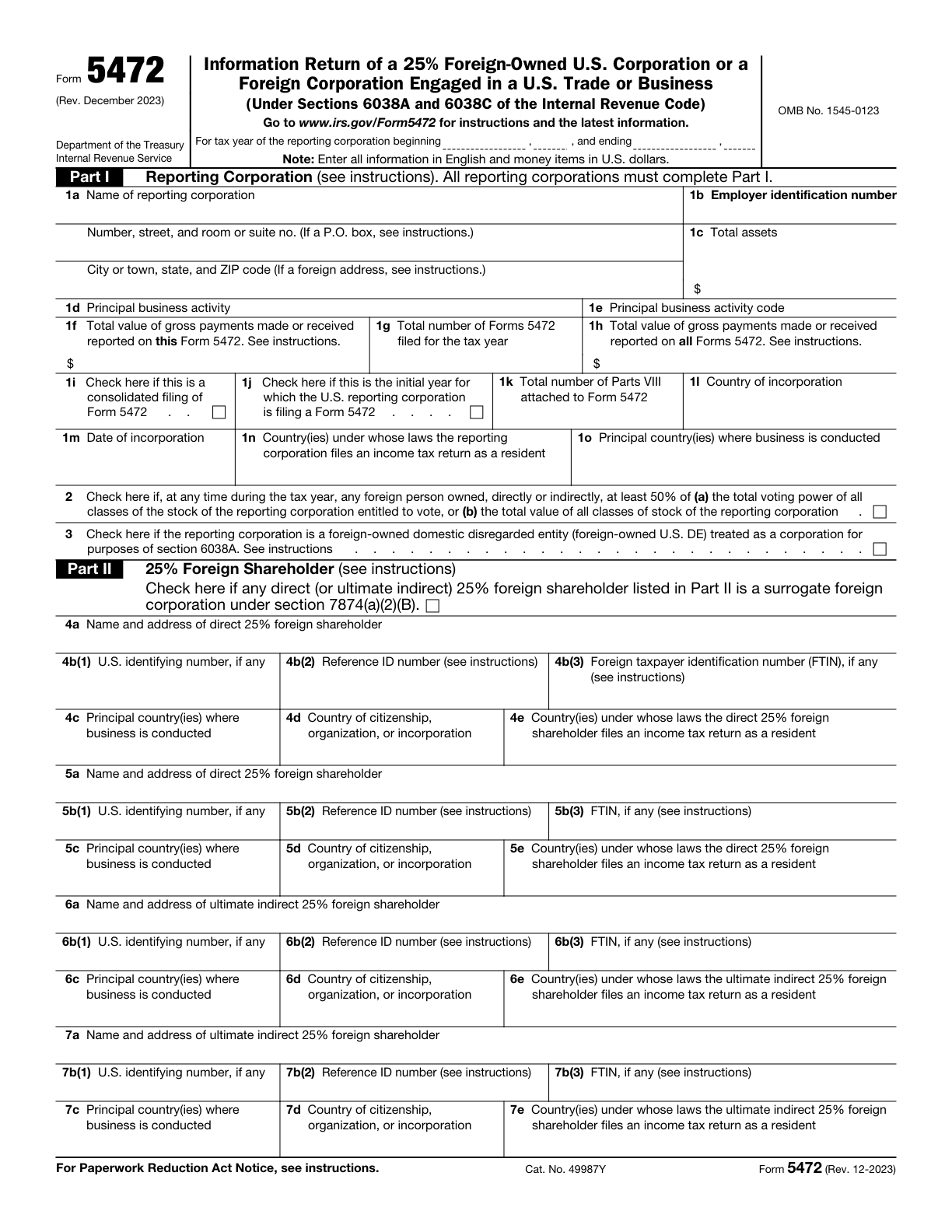
| Official field 5472 8a: Name and address of related party | Enter the name and address of the related party with reportable transactions covered by this particular Form 5472. | — | [1, p.2] [2, p.5] |
| Legal name | Line 1 requires the applicant's legal name, consistent with the applicable Social Security card, formation document or other legal document. | — | [3, p.2] |
| Part5 other de transactions | A foreign-owned U.S. DE checks Part V and attaches a description for other specified transactions not reported in Part IV, including receipts and payments connected with formation, dissolution, acquisition, disposition, contributions and distributions. | Foreign-owned U.S. disregarded entity. The relevant transactions have not been reported in Part IV. | [2, p.6] |
| Related party repeat part3 | Every filer completes Part III, even when that related party was already identified in Part II as a 25% foreign shareholder. | — | [2, p.5] |
Read the requirements in context
Reference id when missing us id
When the applicable foreign shareholder has no U.S. identifying number entered in Part II, use the reference ID required by the instructions. The reporting entity or its representative creates this ID; it is not a separate IRS application.[2, p.4]
De ftin none
A foreign-owned U.S. DE reports its direct and ultimate foreign owners' FTINs, if any. If an owner has no FTIN, enter "None" or "N/A" in that field. Different reporting-entity rules must be checked separately.[2, p.5]
When this applies: Foreign-owned U.S. disregarded entity.
Line1f value
Item 1f is the total U.S.-dollar value of foreign-related-party transactions on that Form 5472, including Part V for a foreign-owned U.S. DE. Do not complete 1f for transactions with a U.S. related party.[2, p.3]
Exchange rate schedule
Report Part IV and VI amounts in U.S. dollars and attach a schedule of exchange rates used. Paid and received include applicable accrued payments and receipts for an accrual-method taxpayer.[2, p.5]
A worked preparation example
This example is hypothetical; it shows how to organize the facts, not an agency decision.
Imagine an owner provides records in two languages, with several descriptions for what may be the same transaction. The working glossary retains each original phrase and its document location. Beside it, the preparer writes the proposed English description and identifies whether the wording is a direct description of the record or an interpretation requiring clarification. Names and identifiers remain connected to the party records so that changing a working description does not silently create a new person or entity. A payment label that could describe different arrangements is left as an open question until the underlying explanation is supported. The amount and original currency stay linked to the same record; any reporting conversion is handled in a separate calculation trail. The preparer can now compare the proposed English form wording with the original context and explain where uncertainty remains. This hypothetical does not claim that the glossary is an official IRS translation form, decide whether a particular separate proceeding requires certification or turn the owner's preferred English label into a binding tax result. It creates a usable bridge between the language of the records and the information being prepared for a specified field.[1, p.1] [2, p.3] [1, p.2] [2, p.5]
Turn the records into a usable filing plan
Review the glossary for consistent meaning, not merely consistent spelling. If the same party appears in Part II and Part III, the identity trail should make that connection clear while preserving the requirement to complete the appropriate sections. If different original descriptions are grouped into one working category, record the reason and the items included so another reviewer can test that choice. Keep unknown FTIN facts and applicable reference-ID requirements separate from translation questions; they cannot be solved by translating a blank into a convenient placeholder. Ask about annual preparation using the supported entity and owner facts, along with any terminology questions that may affect scope. SpeedEIN's standard package does not become a certified-translation service, a personal tax engagement or a transfer-pricing, withholding or corporate-return opinion by implication. The final deliverable is a source-linked vocabulary and field map that helps reviewers recognize both supported descriptions and questions requiring further evidence.[1, p.1] [2, p.3] [1, p.2] [2, p.5]
Three checks before you proceed
- Can each working English description be traced to the original record and its relevant passage?
- Have names, identifiers, amounts and currency conversion remained distinct from transaction-character judgments?
- Are unresolved language or meaning questions visible without asserting a universal certification requirement or exemption?
Related preparation guides
- Preparing a Part V Attachment: Turn the Ledger Into a Clear Transaction Description
- Unpaid Related-Party Invoices at Year End: Identify the Accounting-Method Question
- Trace Every Reported Amount Back to Owner and Bank Records
Official sources and document versions
Official source versions checked: 2026-11-10
- Form 5472 (Rev. December 2023) — Rev. December 2023
- Instructions for Form 5472 (Rev. December 2024) — Rev. December 2024
- Instructions for Form SS-4 (Rev. December 2025) — Rev. December 2025
Get help with the relevant SpeedEIN service
SpeedEIN provides preparation and support within the scope described on its service pages. Review the supported entity types, required information and current service scope before ordering. IRS decisions, processing and any applicable filing or payment obligations remain governed by the official rules.