Unpaid Related-Party Invoices at Year End: Identify the Accounting-Method Question
· 6 min read
The answer for this situation
An unpaid invoice can disappear from a preparation file when the bank statement is treated as the only transaction record. Create an invoice-payment-accrual bridge before drawing that conclusion. For each related-party item, connect the document, the transaction description, any payment and the question about how the applicable accounting method treats it. The bridge should make year-end gaps visible without declaring that every unpaid invoice is reportable in the invoice year. It is equally important not to assume that no bank transfer means no relevant transaction. A useful outcome is a specific list of accounting-method and period questions, with records attached, that can be reviewed before amounts are placed on a Form 5472 schedule.[1, p.5] [1, p.3] [1, p.2]
Which facts change the answer?
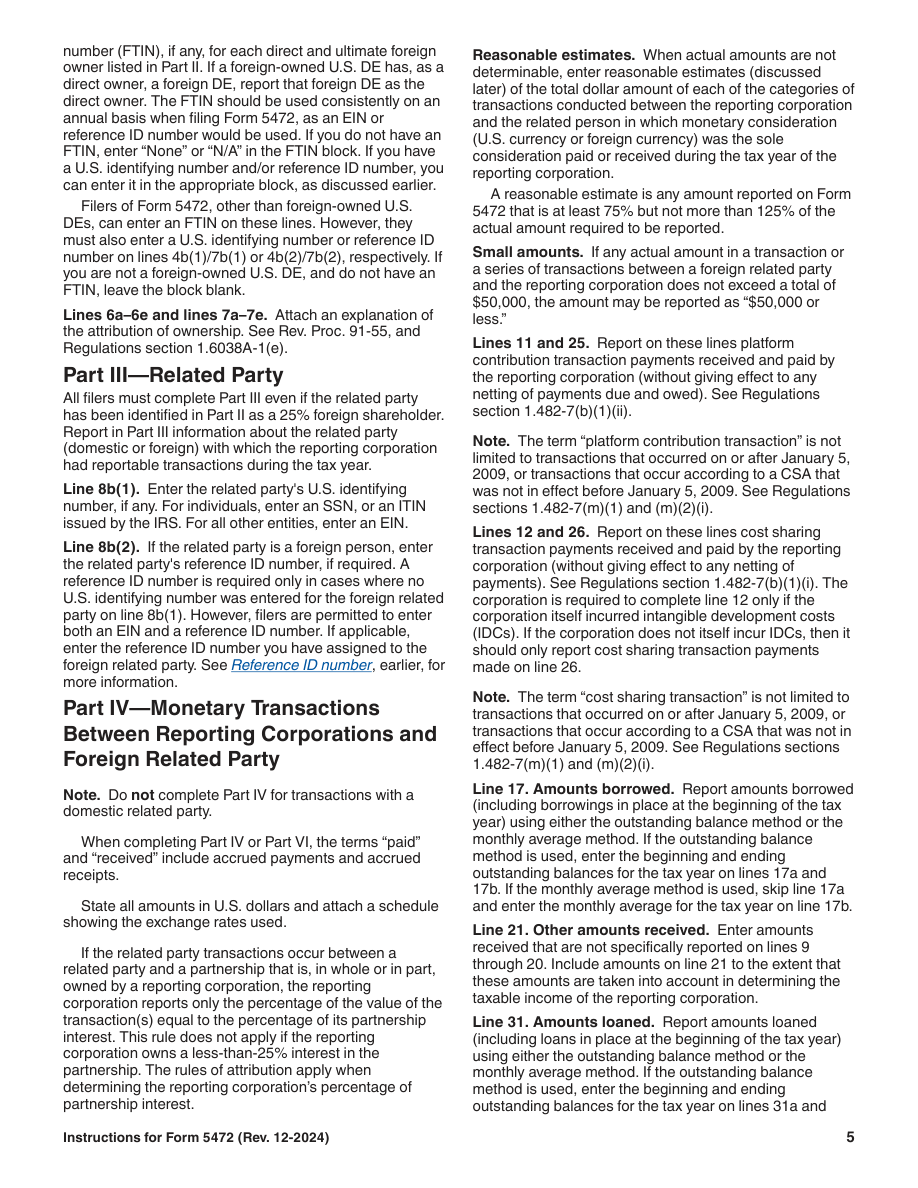
The Form 5472 instructions state that paid and received include applicable accrued payments and receipts for an accrual-method taxpayer. The selected service categories likewise preserve that qualification; it is not a direction to place every applicant on an accrual method. Part IV and VI amounts are reported in U.S. dollars with an attached schedule of exchange rates used. The relevant entity tax year must also be identified: a foreign-owned U.S. DE follows its owner's U.S. filing tax year or the calendar-year fallback where the owner has none. Invoice dates, payment dates and the applicable reporting period therefore need distinct entries in the preparation bridge.[1, p.5] [1, p.3] [1, p.2]
The official requirements, compared
| Question or field | Official instruction | Conditions and limits | Source |
|---|---|---|---|
| Exchange rate schedule | Report Part IV and VI amounts in U.S. dollars and attach a schedule of exchange rates used. Paid and received include applicable accrued payments and receipts for an accrual-method taxpayer. | — | [1, p.5] |
| Records sufficiency | Keep permanent books and records sufficient to establish the correctness of the federal return and the treatment of related-party transactions, together with the detailed requirements of Regulations section 1.6038A-3. | — | [1, p.3] |
| Reportable transaction trigger | A reporting corporation generally files Form 5472 when it has a reportable transaction with a foreign or U.S. related party during the tax year. Operating revenue alone does not determine the filing requirement. | — | [1, p.2] |
| Official field 5472 15: Consideration received for technical, managerial, engineering, construction, scientific, or like services | If this foreign-related-party transaction occurred, report its U.S.-dollar amount under Consideration received for technical, managerial, engineering, construction, scientific, or like services. Include accrued receipts or payments where the accrual method applies. | Part IV concerns transactions with foreign related parties, not domestic related parties. | [2, p.2] [1, p.5] |
| Official field 5472 29: Consideration paid for technical, managerial, engineering, construction, scientific, or like services | If this foreign-related-party transaction occurred, report its U.S.-dollar amount under Consideration paid for technical, managerial, engineering, construction, scientific, or like services. Include accrued receipts or payments where the accrual method applies. | Part IV concerns transactions with foreign related parties, not domestic related parties. | [2, p.2] [1, p.5] |
| Line1f value | Item 1f is the total U.S.-dollar value of foreign-related-party transactions on that Form 5472, including Part V for a foreign-owned U.S. DE. Do not complete 1f for transactions with a U.S. related party. | — | [1, p.3] |
Read the requirements in context
English usd
Provide Form 5472 information in English and report amounts in U.S. dollars.[2, p.1]
Separate related party form
Prepare a separate Form 5472 for each foreign or U.S. related party with which the reporting corporation had reportable transactions. Item 1g is the total number of Forms 5472 for that tax year.[1, p.3]
De tax year
A foreign-owned U.S. DE uses the tax year its owner uses for U.S. tax filing. If the owner does not have such a tax year, the DE uses a calendar year.[1, p.2]
Part5 other de transactions
A foreign-owned U.S. DE checks Part V and attaches a description for other specified transactions not reported in Part IV, including receipts and payments connected with formation, dissolution, acquisition, disposition, contributions and distributions.[1, p.6]
When this applies: Foreign-owned U.S. disregarded entity. The relevant transactions have not been reported in Part IV.
A worked preparation example
This example is hypothetical; it shows how to organize the facts, not an agency decision.
Suppose a related-party service invoice remains unpaid when the owner begins annual preparation. The bridge records the invoice date, what it says the charge concerns, the party identified and the available evidence about payments. A later payment can be linked back to the invoice without silently deciding which year's reporting includes the amount. The accounting-method question stays beside that record so the reviewer can identify whether the accrued-payment qualification applies. If the invoice currency differs from the reporting currency, the original record remains available and the applicable conversion support is marked for preparation. A second item with incomplete service documentation is held as a separate question rather than treated as identical merely because both invoices are unpaid. The preparer can now explain why the bank total and the invoice file do not match. This hypothetical does not adopt or change an accounting method, prescribe a year-end deduction or conclude that every open payable is a Form 5472 amount. It produces an evidence bridge that distinguishes timing facts from their eventual tax treatment and allows unresolved amounts to remain visible instead of disappearing from the file.[1, p.5] [1, p.3] [1, p.2]
Turn the records into a usable filing plan
Give the bridge a clear review outcome for each item: documented payment connection, outstanding support or accounting-method determination still needed. Keep the original transaction evidence even after the eventual form mapping is settled, so the reasoning can be traced. A reporting corporation's Form 5472 question still depends on reportable transactions with relevant related parties, and the party-specific form and transaction-value rules continue to apply. For a foreign-owned U.S. DE, evaluate any relevant Part V item under its own conditions rather than using that part as a general destination for unresolved accrual questions. Ask a preparation service to assess its supported scope with the actual open-invoice facts disclosed. SpeedEIN's ordinary individual-owned U.S. DE annual package does not imply accounting-method advice, transfer-pricing analysis, corporate returns, withholding or personal tax work. The bridge helps identify which questions need that separate review; it is not a promise that an unpaid item can be omitted, delayed or included simply to match the available cash records.[1, p.5] [1, p.3] [1, p.2]
Three checks before you proceed
- Does each open invoice remain connected to its transaction description, counterparty and any later payment?
- Has the applicable accounting method been identified without assuming every invoice follows the same timing rule?
- Are the tax period, currency support and unresolved treatment questions visible before form amounts are finalized?
Related preparation guides
- The LLC Pays Its Owner for Work: What Changes in the Preparation File?
- Payment-Processor Statements and Form 5472: Separate Sales Receipts From Owner Transfers
- Non-U.S.-Dollar Transactions: Prepare a Conversion Schedule Before Filing
Official sources and document versions
Official source versions checked: 2026-11-10
- Instructions for Form 5472 (Rev. December 2024) — Rev. December 2024
- Form 5472 (Rev. December 2023) — Rev. December 2023
Get help with the relevant SpeedEIN service
SpeedEIN provides preparation and support within the scope described on its service pages. Review the supported entity types, required information and current service scope before ordering. IRS decisions, processing and any applicable filing or payment obligations remain governed by the official rules.