Preparing a Part V Attachment: Turn the Ledger Into a Clear Transaction Description
· 6 min read
The answer for this situation
A ledger can contain the right source material while still leaving a reader unable to understand the transactions described in a Part V attachment. Build an attachment map between the underlying entries and the proposed English explanation. Each proposed description should point to the relevant party, period, supporting records and reconciled amount where applicable. This is an editorial preparation layout, not a newly prescribed IRS attachment template. Its value is that a reviewer can see what the explanation covers and return to the evidence supporting it. The task goes beyond collecting formation-payment documents: it turns supported transaction facts into a coherent account while keeping unresolved character or scope questions out of a falsely definitive narrative.[1, p.6] [2, p.2] [1, p.3]
Which facts change the answer?
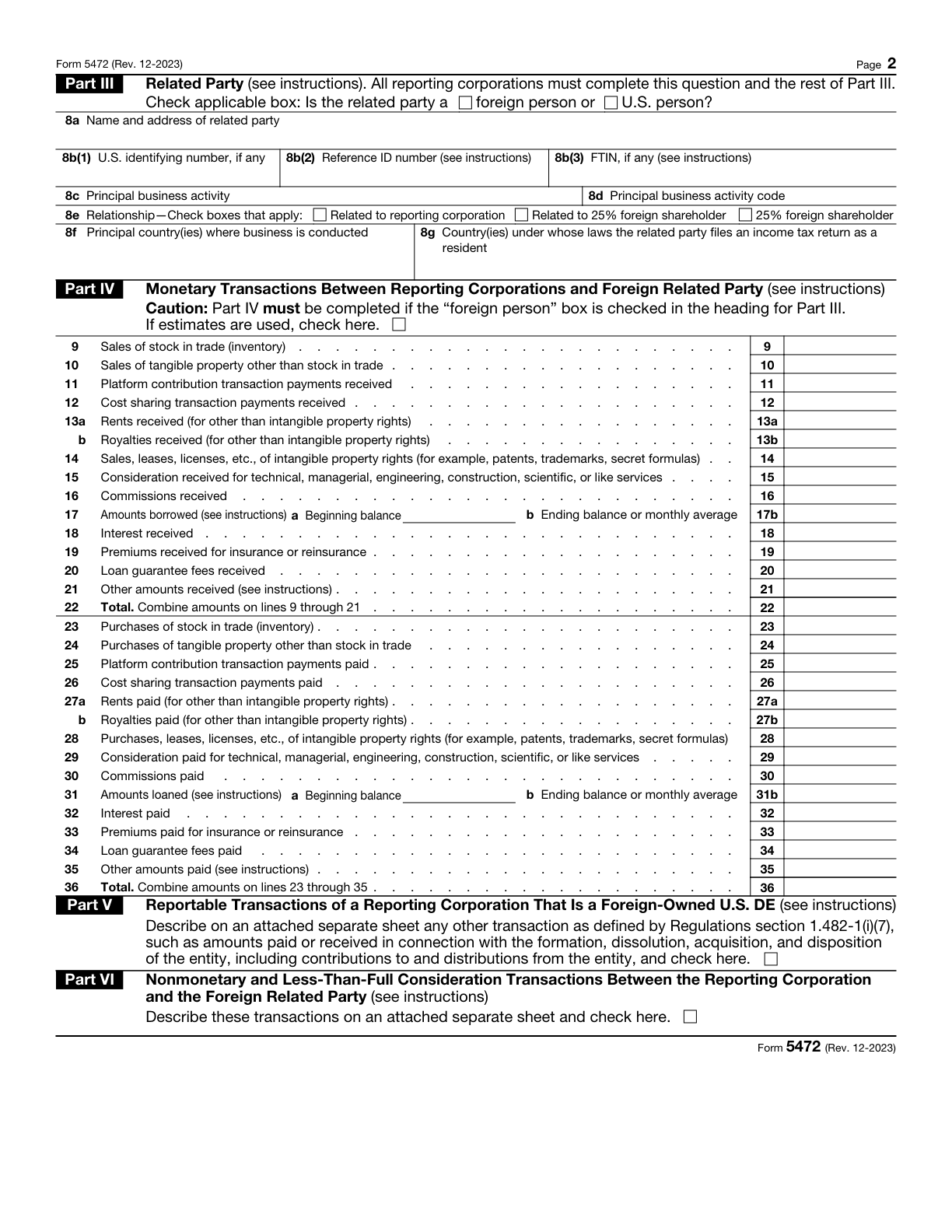
The Part V instruction applies to a foreign-owned U.S. DE with other specified transactions not reported in Part IV, including applicable formation, dissolution, acquisition, disposition, contribution and distribution activity. Those conditions must remain attached to the preparation decision; Part V is not a catch-all for every unexplained ledger entry. Form 5472 reporting depends on the relevant entity and related-party transaction facts. The DE's tax year follows its owner's U.S. filing year, or the calendar-year fallback if the owner has none. Keep that period, the party-specific form and the English/U.S.-dollar reporting requirements visible in the attachment map rather than adding an unlabelled narrative to a packet.[1, p.6] [2, p.2] [1, p.3]
The official requirements, compared
| Question or field | Official instruction | Conditions and limits | Source |
|---|---|---|---|
| Part5 other de transactions | A foreign-owned U.S. DE checks Part V and attaches a description for other specified transactions not reported in Part IV, including receipts and payments connected with formation, dissolution, acquisition, disposition, contributions and distributions. | Foreign-owned U.S. disregarded entity. The relevant transactions have not been reported in Part IV. | [1, p.6] |
| Official field 5472 Part V attachment: Reportable Transactions of a Reporting Corporation That Is a Foreign-Owned U.S. DE | If a foreign-owned U.S. DE has other specified transactions not reported in Part IV, check Part V and attach the description, including applicable formation, dissolution, contribution and distribution transactions. | — | [2, p.2] [1, p.6] |
| Records sufficiency | Keep permanent books and records sufficient to establish the correctness of the federal return and the treatment of related-party transactions, together with the detailed requirements of Regulations section 1.6038A-3. | — | [1, p.3] |
| Reportable transaction trigger | A reporting corporation generally files Form 5472 when it has a reportable transaction with a foreign or U.S. related party during the tax year. Operating revenue alone does not determine the filing requirement. | — | [1, p.2] |
| Line1f value | Item 1f is the total U.S.-dollar value of foreign-related-party transactions on that Form 5472, including Part V for a foreign-owned U.S. DE. Do not complete 1f for transactions with a U.S. related party. | — | [1, p.3] |
| Separate related party form | Prepare a separate Form 5472 for each foreign or U.S. related party with which the reporting corporation had reportable transactions. Item 1g is the total number of Forms 5472 for that tax year. | — | [1, p.3] |
Read the requirements in context
Related party repeat part3
Every filer completes Part III, even when that related party was already identified in Part II as a 25% foreign shareholder.[1, p.5]
English usd
Provide Form 5472 information in English and report amounts in U.S. dollars.[2, p.1]
De tax year
A foreign-owned U.S. DE uses the tax year its owner uses for U.S. tax filing. If the owner does not have such a tax year, the DE uses a calendar year.[1, p.2]
Foreign owned us de definition
A foreign-owned U.S. disregarded entity is a domestic disregarded entity wholly owned by a foreign person. Its treatment as a corporation for these purposes is limited to the reporting requirements related to section 6038A.[1, p.2]
A worked preparation example
This example is hypothetical; it shows how to organize the facts, not an agency decision.
Suppose a supported foreign-individual-owned U.S. DE has ledger entries described as owner funding and later movements back to the owner. The preparer first checks the supporting records and the proposed Part V applicability, including whether a transaction has already been reported in Part IV. The map then gives each supported description a reference to its ledger entries and source documents. An explanation of formation-related activity is kept distinct from a later distribution description instead of being compressed into a general sentence that funds moved. If the ledger and proposed narrative use different amounts, the preparer resolves that discrepancy or records the question before the explanation is finalized. Each attachment item is associated with the relevant party-specific Form 5472, so its role in the packet is clear. The hypothetical ends with a draft that another reviewer can trace from narrative to ledger and back. It does not invent transaction character from an unexplained balance, require a particular proprietary layout or claim that a polished description by itself satisfies every recordkeeping obligation. An unresolved item stays in the preparation issue list rather than being converted into official-sounding prose merely to complete the attachment.[1, p.6] [2, p.2] [1, p.3]
Turn the records into a usable filing plan
Read the proposed attachment independently, then test it against the map. A reader should be able to identify the relevant activity and return to the records without guessing which period or party is meant. Item 1f includes Part V for the foreign-owned U.S. DE where the foreign-related-party scope applies; reconcile the corresponding figures without treating operating revenue as the transaction total. The separate-form and Part III rules remain applicable even if the owner is also identified in Part II. Keep sufficient books and records to support the treatment, not just the final wording. If a classification or specialized tax question remains, state it rather than assuming the standard annual service resolves it. SpeedEIN's package scope is limited to its supported U.S.-formed single-member DE with a nonresident individual owner and supported facts; corporate income returns, personal tax, withholding and transfer-pricing work are not included by implication. The useful output is a clear, evidence-linked description ready for the appropriate review.[1, p.6] [2, p.2] [1, p.3]
Three checks before you proceed
- Does each proposed Part V description meet the entity and transaction conditions and avoid duplicating Part IV reporting?
- Can a reviewer trace the description, party, period and amount back to specific ledger entries and records?
- Are unresolved classifications kept open instead of being hidden inside a polished but unsupported attachment narrative?
Related preparation guides
- Payment-Processor Statements and Form 5472: Separate Sales Receipts From Owner Transfers
- Personal and LLC Transactions Share a Statement: Build a Reviewable Separation Ledger
- Formation Payments in Part V: Build a Source-Document List
Official sources and document versions
Official source versions checked: 2026-11-10
- Instructions for Form 5472 (Rev. December 2024) — Rev. December 2024
- Form 5472 (Rev. December 2023) — Rev. December 2023
Get help with the relevant SpeedEIN service
SpeedEIN provides preparation and support within the scope described on its service pages. Review the supported entity types, required information and current service scope before ordering. IRS decisions, processing and any applicable filing or payment obligations remain governed by the official rules.