Last Year's Closing Records and This Year's Filing: Preserve the Correct Opening Information
· 6 min read
The answer for this situation
Use last year's closing records as a starting reference, not as a set of numbers to paste into this year's Form 5472. A continuity sheet can connect the same counterparty and identifier across periods, show relevant opening balance information and identify which current-year records support the new preparation. Give each item a clear label: prior-period reference, current-period fact or unresolved difference. That distinction prevents a previously reported transaction total from being mistaken for a current-year amount merely because it sits in the opening file. It also makes changes in counterparties visible instead of letting a new person inherit a discontinued identifier. The useful result is a documented bridge between periods, with separate questions for balances, annual transactions and the reporting-year facts that govern the work.[1, p.4] [1, p.5] [1, p.6]
Which facts change the answer?
The cited balance directions distinguish outstanding-balance and monthly-average reporting approaches for borrowing and lending. They should be applied to the relevant direction and counterparty, rather than combined into one carry-forward figure. The reference-ID guidance concerns consistent identification of the same person and does not permit a discontinued ID to be reassigned to someone else. This article does not determine how an unexplained prior-year error should be corrected or conclude that matching two spreadsheet totals proves the filing treatment correct. Any unclear reporting-year or underlying transaction issue remains a separate matter for appropriate review.[1, p.4] [1, p.5] [1, p.6]
The official requirements, compared
| Question or field | Official instruction | Conditions and limits | Source |
|---|---|---|---|
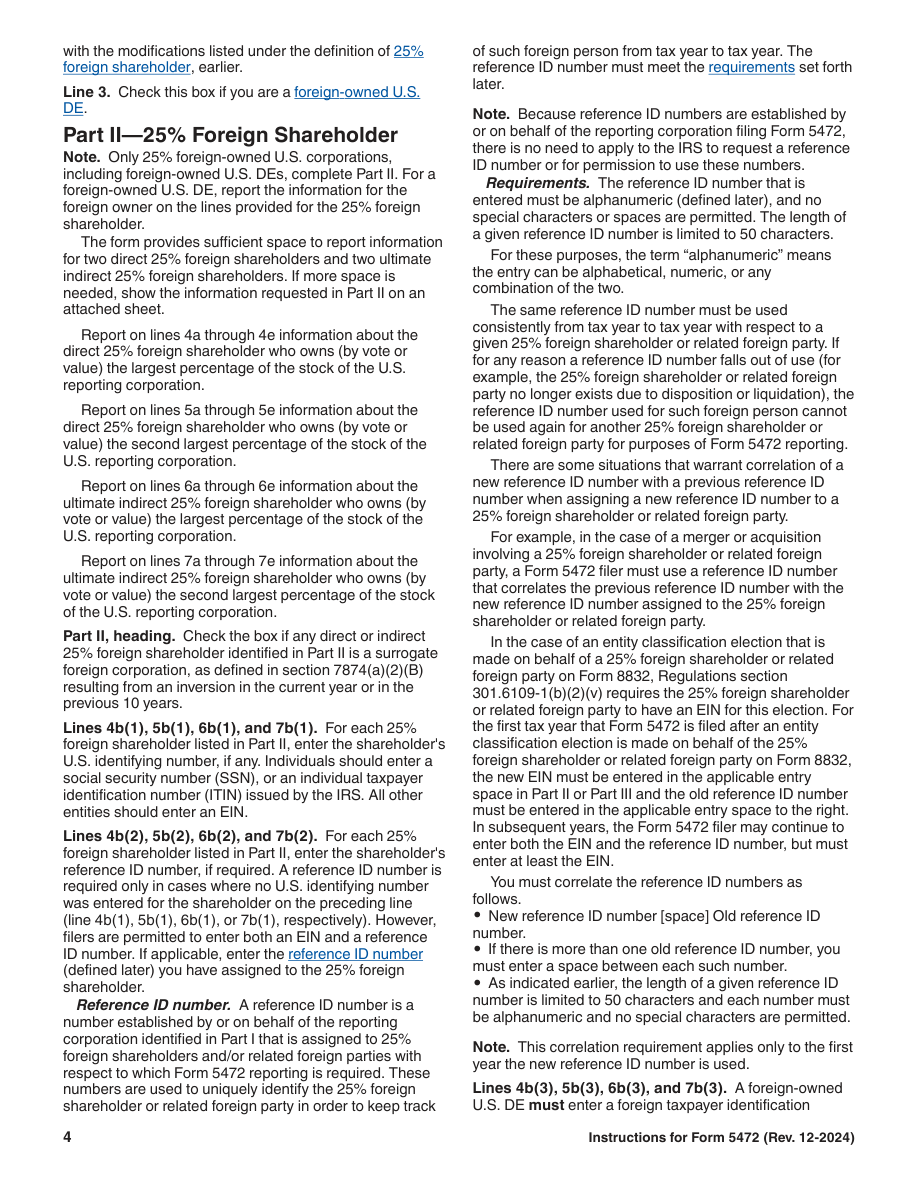
| Reference id format | A reference ID may consist of letters only, numbers only, or a combination of letters and numbers, with no spaces or special characters and no more than 50 characters. Keep it consistent for the same person across years, and do not reassign a discontinued ID to another person. | — | [1, p.4] |
| Borrowed balance method | For amounts borrowed on line 17, the outstanding-balance method uses beginning and ending balances on 17a and 17b. Under the monthly-average method, skip 17a and enter the monthly average on 17b. | — | [1, p.5] |
| Loaned balance method | For amounts loaned on line 31, the outstanding-balance method uses beginning and ending balances. Under the monthly-average method, skip 31a and enter the monthly average on 31b. | — | [1, p.5] [1, p.6] |
| Records sufficiency | Keep permanent books and records sufficient to establish the correctness of the federal return and the treatment of related-party transactions, together with the detailed requirements of Regulations section 1.6038A-3. | — | [1, p.3] |
| De tax year | A foreign-owned U.S. DE uses the tax year its owner uses for U.S. tax filing. If the owner does not have such a tax year, the DE uses a calendar year. | — | [1, p.2] |
| Separate related party form | Prepare a separate Form 5472 for each foreign or U.S. related party with which the reporting corporation had reportable transactions. Item 1g is the total number of Forms 5472 for that tax year. | — | [1, p.3] |
Read the requirements in context
Line1f value
Item 1f is the total U.S.-dollar value of foreign-related-party transactions on that Form 5472, including Part V for a foreign-owned U.S. DE. Do not complete 1f for transactions with a U.S. related party.[1, p.3]
Related party repeat part3
Every filer completes Part III, even when that related party was already identified in Part II as a 25% foreign shareholder.[1, p.5]
A worked preparation example
This example is hypothetical; it shows how to organize the facts, not an agency decision.
Imagine a hypothetical LLC whose prior-year folder contains a foreign owner's reference ID, a closing loan schedule and a total of related-party transactions. A new preparer starts the following year's worksheet by copying the whole prior tab. On review, the owner notices that the current records include a different related party and repayments during the period. A continuity sheet is used to separate the copied information. The old identifier stays connected with its original person; the newly appearing party is not placed under it just because that row already exists. The closing borrowing record becomes a reference for the relevant opening-balance question, while the new transactions are assembled from current-period records. Lending information is kept separate if it is also present. The preparer records which balance approach is being considered instead of carrying an old ending amount into every available line. An unexplained difference between the old closing record and the proposed opening information is left as a reconciliation question with named source references. This hypothetical process produces a traceable period-to-period bridge, without treating last year's item 1f total as this year's transaction value or deciding an unsupported correction procedure.[1, p.4] [1, p.5] [1, p.6]
Turn the records into a usable filing plan
Before carrying information forward, ask what each old number represents and what role it has in the current preparation. A reference identifier, a balance and a tax-year transaction total serve different purposes, even if they appeared next to one another in the earlier file. Keep the original record identifiable and place later explanations beside it rather than silently rewriting the historical copy. When a discrepancy remains, describe the difference precisely so the preparer can investigate the relevant period and counterparty. The continuity sheet is an internal organizing aid, not a replacement for sufficient books and records or a fixed government-required attachment. When considering SpeedEIN's supported annual service, disclose missing opening information or prior-period uncertainty early. An ordinary preparation package should not be assumed to include reconstruction of every historical balance or specialist correction advice.[1, p.4] [1, p.5] [1, p.6]
Three checks before you proceed
- Which carried-forward items are identifiers, relevant balance references or prior-year transaction totals, and have their different roles been preserved?
- Does the current counterparty list keep each identifier attached to the same person without reassigning a discontinued ID?
- What records explain any opening-information difference, and which current-year facts still need to be established before preparation?
Related preparation guides
- Changing Bookkeepers: Recover the Records Needed for a Form 5472 Filing
- Related-Party Loan Balances: Choose a Supported Working Schedule Before Filing
- Trace Every Reported Amount Back to Owner and Bank Records
Official sources and document versions
Official source versions checked: 2026-11-10
- Instructions for Form 5472 (Rev. December 2024) — Rev. December 2024
Get help with the relevant SpeedEIN service
SpeedEIN provides preparation and support within the scope described on its service pages. Review the supported entity types, required information and current service scope before ordering. IRS decisions, processing and any applicable filing or payment obligations remain governed by the official rules.