Related-Party Loan Balances: Choose a Supported Working Schedule Before Filing
· 6 min read
The answer for this situation
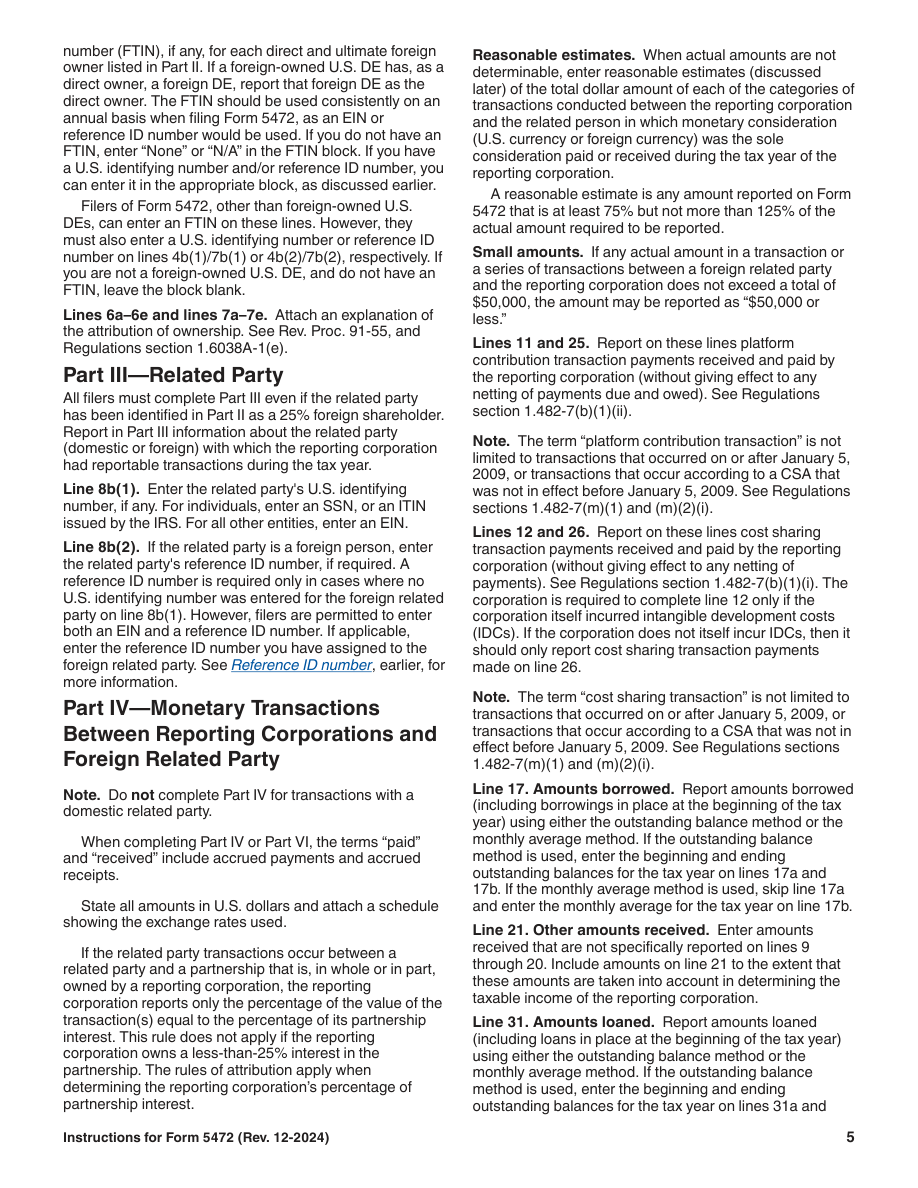
A related-party loan schedule is useful only when it makes clear who owes whom, which counterparty is involved and which reporting approach the records support. A single number labelled loans can hide both directions of lending and several different periods. Before transferring a balance to Form 5472, separate amounts borrowed by the reporting entity from amounts it loaned to the relevant party, then identify the records available for the beginning, end and intervening months. This produces a preparation schedule rather than an unsupported choice between two attractive-looking figures. The official line directions distinguish the outstanding-balance and monthly-average approaches; the work should preserve that distinction instead of filling both approaches into the same fields or treating a blank beginning field as evidence of a zero balance.[1, p.5] [1, p.6] [1, p.3]
Which facts change the answer?
The cited Part IV instructions concern foreign-related-party transactions, not domestic-related-party transactions. Confirm that the counterparty and the proposed entries belong in that scope before comparing methods. This article does not decide whether a transfer is legally debt rather than capital, determine financing terms or provide transfer-pricing analysis. It also does not invent a monthly-average calculation from incomplete records. If the nature of the arrangement or the applicable reporting treatment is unclear, identify that as a separate question before treating any working schedule as ready for transcription.[1, p.5] [1, p.6] [1, p.3]
The official requirements, compared
| Question or field | Official instruction | Conditions and limits | Source |
|---|---|---|---|
| Borrowed balance method | For amounts borrowed on line 17, the outstanding-balance method uses beginning and ending balances on 17a and 17b. Under the monthly-average method, skip 17a and enter the monthly average on 17b. | — | [1, p.5] |
| Loaned balance method | For amounts loaned on line 31, the outstanding-balance method uses beginning and ending balances. Under the monthly-average method, skip 31a and enter the monthly average on 31b. | — | [1, p.5] [1, p.6] |
| Records sufficiency | Keep permanent books and records sufficient to establish the correctness of the federal return and the treatment of related-party transactions, together with the detailed requirements of Regulations section 1.6038A-3. | — | [1, p.3] |
| Official field 5472 17a: Beginning balance | Under the outstanding-balance method, enter the beginning balance. Under the monthly-average method, leave this a-field blank and use the corresponding b-field. | Part IV concerns transactions with foreign related parties, not domestic related parties. | [2, p.2] [1, p.5] |
| Official field 5472 17b: Ending balance or monthly average | Enter the ending balance under the outstanding-balance method, or the tax year's monthly average under the monthly-average method. | Part IV concerns transactions with foreign related parties, not domestic related parties. | [2, p.2] [1, p.5] |
| Official field 5472 31a: Beginning balance | Under the outstanding-balance method, enter the beginning balance. Under the monthly-average method, leave 31a blank and report the amount on 31b. | Part IV concerns transactions with foreign related parties, not domestic related parties. | [2, p.2] [1, p.5] |
Read the requirements in context
Official field 5472 31b: Ending balance or monthly average
Enter the ending balance under the outstanding-balance method, or the tax year's monthly average under the monthly-average method.[2, p.2] [1, p.5]
When this applies: Part IV concerns transactions with foreign related parties, not domestic related parties.
Separate related party form
Prepare a separate Form 5472 for each foreign or U.S. related party with which the reporting corporation had reportable transactions. Item 1g is the total number of Forms 5472 for that tax year.[1, p.3]
Reportable transaction trigger
A reporting corporation generally files Form 5472 when it has a reportable transaction with a foreign or U.S. related party during the tax year. Operating revenue alone does not determine the filing requirement.[1, p.2]
A worked preparation example
This example is hypothetical; it shows how to organize the facts, not an agency decision.
Imagine a hypothetical LLC that borrowed from its foreign owner and also has a separate amount described as lent to another foreign related party. The bookkeeper exports one net loans figure. A preparer first separates the counterparties and the two directions, keeping a distinct record for each proposed Form 5472. For the borrowing record, the preparer gathers the relevant opening and closing balance information and identifies whether monthly records are available. For the lending record, the same evidence review is performed independently rather than copying the borrowing total with a different sign. The working sheet records the approach under consideration and the fields that approach would use. A missing monthly record remains a gap; it is not silently replaced by the year-end amount so a complete-looking average can be presented. The preparer also keeps repayments and other movements visible while reconciling the schedule, without claiming that the net bank movement itself is the required balance. This hypothetical exercise produces two traceable sets of information and a clear list of unresolved matters. It does not validate the financing arrangement or make an unsupported transaction acceptable for an ordinary preparation service.[1, p.5] [1, p.6] [1, p.3]
Turn the records into a usable filing plan
Give each schedule a direction, counterparty, reporting period, source references and a clear indication of the reporting approach being reviewed. Before using it, compare the field instructions with the selected approach and confirm that a value intended for one balance field has not been repeated elsewhere simply to avoid leaving a field blank. Where monthly information is insufficient, record exactly what is missing and ask the appropriate preparer how to resolve it; a spreadsheet formula does not supply missing facts. Keep the distinction between the underlying debt question and the presentation of a supported balance. SpeedEIN's standard annual service should not be assumed to include financing tax advice, debt characterization or transfer-pricing work. Explain any loan arrangement before ordering, so the service can assess the facts and the scope rather than receiving an unexplained total after work begins.[1, p.5] [1, p.6] [1, p.3]
Three checks before you proceed
- Is each balance identified as an amount borrowed or an amount loaned, with the correct foreign related party?
- Do the records support the reporting approach and the particular beginning, ending or monthly-average field being prepared?
- Which missing balances or underlying financing questions remain unresolved instead of being hidden inside a net loans figure?
Related preparation guides
- Changing Bookkeepers: Recover the Records Needed for a Form 5472 Filing
- Last Year's Closing Records and This Year's Filing: Preserve the Correct Opening Information
- A Related-Party Loan Can Move a Filing Beyond a Simplified Cash-Transfer Workflow
Official sources and document versions
Official source versions checked: 2026-11-10
- Instructions for Form 5472 (Rev. December 2024) — Rev. December 2024
- Form 5472 (Rev. December 2023) — Rev. December 2023
Get help with the relevant SpeedEIN service
SpeedEIN provides preparation and support within the scope described on its service pages. Review the supported entity types, required information and current service scope before ordering. IRS decisions, processing and any applicable filing or payment obligations remain governed by the official rules.