Changing Tax Classification While Keeping the EIN: Avoid Buying the Wrong Application
· 6 min read
The answer for this situation
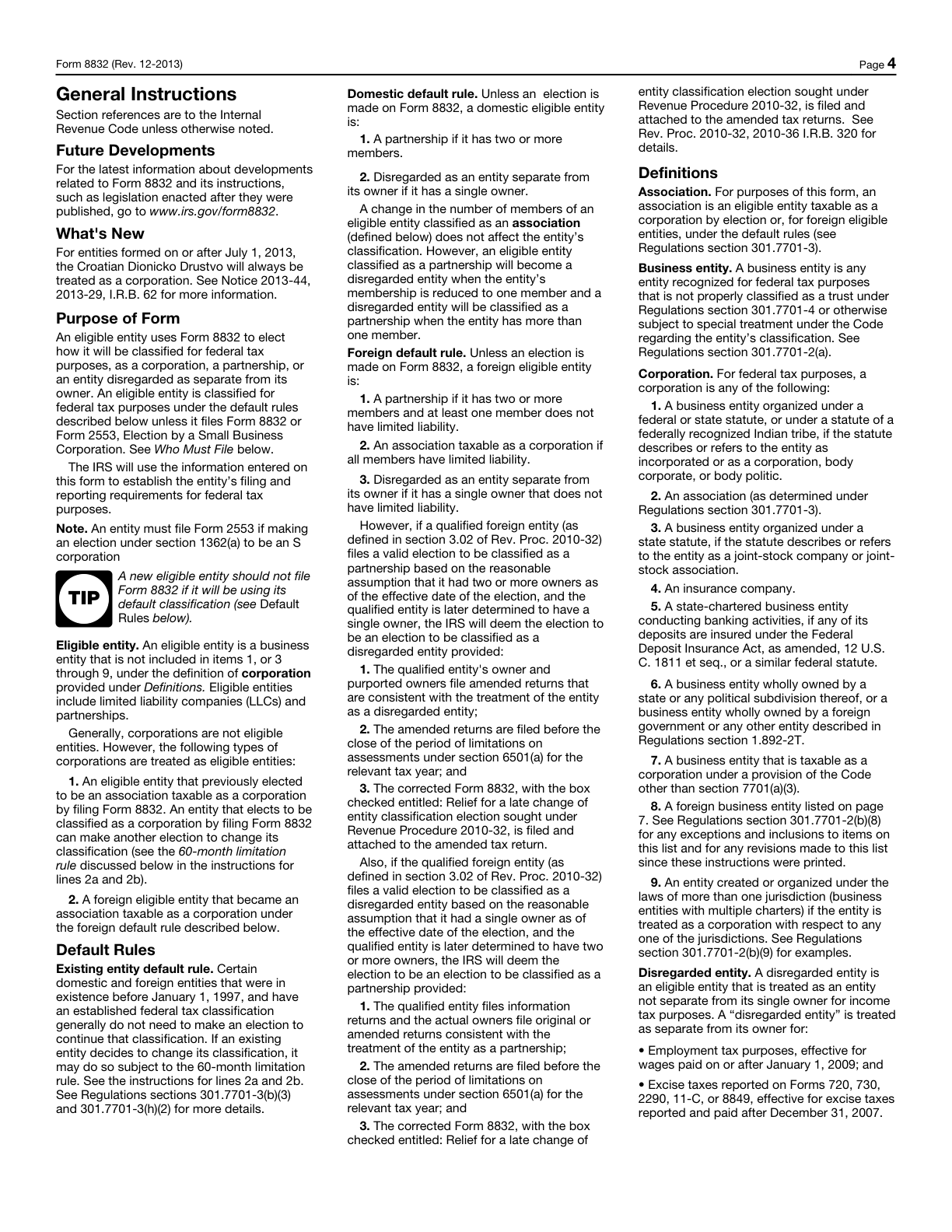
A proposed change in federal tax classification is not automatically a request for a new EIN. Before ordering, create a service-selection note identifying the existing entity, its EIN, the classification history and the treatment already chosen with an adviser. Form 8832 requires the entity's own EIN, and its instructions state that an entity already holding one retains it after a classification change. That fact can prevent the wrong application from being commissioned merely because the owner hears the word change. The note should distinguish the identity question from the election-preparation task and from any separate event involving ownership or structure. Its purpose is to route a supported request accurately, not to recommend the most advantageous tax treatment or assume that every change in a business's circumstances follows the same EIN rule.[1, p.7] [2, p.4] [1, p.5]
Which facts change the answer?
Domestic eligible entities generally have partnership default treatment with two or more members and disregarded default treatment with a single owner, subject to the applicable rules and elections. Accepting default treatment does not require a newly created entity to file Form 8832 merely because it exists. An ordinary election generally has a 75-day lookback and 12-month prospective effective-date window; late relief is separate. A prior election within the preceding 60 months can restrict another change, with the instructions' exceptions reviewed individually. The service-selection note should preserve these conditions rather than treating an existing EIN as proof that any proposed election date is available.[1, p.7] [2, p.4] [1, p.5]
The official requirements, compared
| Question or field | Official instruction | Conditions and limits | Source |
|---|---|---|---|
| Ein required | Form 8832 requires the entity's own EIN; Applied For is not accepted. An entity that already has an EIN retains that EIN after a classification change. | — | [1, p.7] |
| Not entity election | Checking an entity-type box on SS-4 is not itself an entity-classification tax election. | — | [2, p.4] |
| Domestic default | Without an election, a domestic eligible entity with two or more members generally defaults to a partnership; one with a single owner generally defaults to a disregarded entity. | — | [1, p.5] |
| Default not required | A newly formed eligible entity accepting its default classification does not file Form 8832 merely because it was newly created. | — | [1, p.5] |
| Effective window | An ordinary Form 8832 effective date generally cannot precede filing by more than 75 days or follow filing by more than 12 months. Late-election relief is a separate exception requiring its own review. | An ordinary Form 8832 election. Late-election relief for applicants meeting its conditions. | [1, p.6] |
| 60 month change limit | A prior classification election effective within the preceding 60 months generally restricts another classification change. Apply the instructions' exceptions separately, including an initial election by a newly formed entity effective on its formation date. | — | [1, p.2] [1, p.7] |
Read the requirements in context
Return copy
In addition to filing Form 8832 separately, attach a copy to the entity's return for the election year as instructed, or to the applicable direct or indirect owner's return if the entity has no return-filing obligation.[1, p.6]
Previous ein disclosure
Line 18 asks whether the applicant previously received an EIN. If Yes, enter that prior EIN.[3, p.1]
Ein deactivation not cancel
The IRS says an EIN cannot be cancelled, although it can be deactivated; once assigned to an entity it is that entity’s permanent federal taxpayer ID.[4]
When this applies: State dissolution is a separate agency action, not an automatic IRS deactivation.
Name only change no new ein
A name or location change alone generally does not require a new EIN. Ownership or structural changes require separate review. For LLCs, the IRS expressly lists changing the name or location among cases not requiring a new EIN.[5] [6]
When this applies: Only the name or location changes, without an entity, ownership or structural event requiring a new EIN.
Limits to keep: If a reorganization, ownership change or entity-structure change also occurs, apply the rules for that entity type separately. Do not turn the name-change rule into a statement that a new EIN is never required.
A worked preparation example
This example is hypothetical; it shows how to organize the facts, not an agency decision.
Suppose an owner has an existing LLC EIN and has discussed a proposed classification with an adviser. Before buying preparation, the owner writes down the actual entity involved, its current documented position, the desired treatment and the contemplated effective date. The retained-EIN rule is placed beside the identity question so the owner does not request a new number simply to label the election. The history section lists any prior election and its relevant date, with uncertainty recorded where a document is missing. The preparer can then distinguish a standard election question from a matter involving timing restrictions or a separate ownership or structural event. A name change by itself is not used as evidence that a new EIN is needed; any additional event is identified for its own review. The hypothetical ends with a defined task and the facts supporting it. It does not declare the proposed election optimal, manufacture late-relief eligibility or assume that a fresh SS-4 will accomplish the classification change. It also does not erase the prior EIN from the records merely because the filing label may change.[1, p.7] [2, p.4] [1, p.5]
Turn the records into a usable filing plan
Use the decision note to ask for the service that matches the actual job. For Form 8832, Applied For is not an accepted substitute for the entity's required EIN; checking a box on SS-4 is not an election either. Retain the applicable return-copy requirement and the separate timing and history questions when planning preparation. If the current classification or the effect of another business event is unclear, identify that gap before describing the task as a routine election. SpeedEIN's standard election scope is for a U.S. single-individual-owner LLC after the reader has chosen treatment with an adviser. It does not promise S-corporation election work, late-election relief or tax-planning recommendations. The practical deliverable is a supported choice between an election-preparation task and an unresolved identity or history question, not a guarantee that every requested change can be carried out or that ordering another EIN is the correct fallback.[1, p.7] [2, p.4] [1, p.5]
Three checks before you proceed
- Does the request concern the same existing entity and EIN, or a separate ownership or structural event needing review?
- Are the chosen treatment, proposed effective date and prior-election history supported before preparation is ordered?
- Is the requested service a supported standard election rather than a new-number shortcut, late-relief promise or tax-planning engagement?
Related preparation guides
- You Do Not Know the LLC's Current Tax Classification: Reconstruct the Evidence Before Ordering
- Track a Form 8832 Decision From Mailing Evidence to the IRS Letter
- An EIN Is Required Before Completing Form 8832
Official sources and document versions
Official source versions checked: 2026-11-10
- Form 8832 (Rev. December 2013) — Rev. December 2013
- Instructions for Form SS-4 (Rev. December 2025) — Rev. December 2025
- Form SS-4 (Rev. December 2025) — Rev. December 2025
- If you no longer need your EIN
- When to get a new EIN
- Business name change
Get help with the relevant SpeedEIN service
SpeedEIN provides preparation and support within the scope described on its service pages. Review the supported entity types, required information and current service scope before ordering. IRS decisions, processing and any applicable filing or payment obligations remain governed by the official rules.