You Do Not Know the LLC's Current Tax Classification: Reconstruct the Evidence Before Ordering
· 6 min read
The answer for this situation
When the LLC's current federal tax classification is unclear, the next task is to reconstruct its history rather than select a form that seems likely to fit. Build an evidence file containing any prior elections, IRS correspondence, retained return copies and the ownership facts relevant to default treatment. Label what each document can show and what remains unknown. An SS-4 entity-type checkbox is not itself a classification election, and a newly formed eligible entity accepting default treatment does not file Form 8832 merely because it exists. The useful outcome is a dated classification-history register that separates missing paperwork from a proposed new election. It should help an adviser or preparation service understand the problem without implying that a new order will reveal or optimize the correct treatment automatically.[1, p.4] [2, p.5] [2, p.2] [2, p.7]
Which facts change the answer?
Domestic eligible entities generally default to partnership treatment with two or more members and disregarded treatment with one owner, subject to the applicable rules and elections. A prior election effective within the preceding 60 months generally restricts another classification change, with separate exceptions including a newly formed entity's initial election effective on its formation date. Do not treat a missing copy as proof that no election occurred. Conversely, a retained return needs to be understood in context: a foreign-owned U.S. DE's required pro forma Form 1120 with Form 5472 is not, by itself, a reason to call the entity an ordinary income-tax corporation.[1, p.4] [2, p.5] [2, p.2] [2, p.7]
The official requirements, compared
| Question or field | Official instruction | Conditions and limits | Source |
|---|---|---|---|
| Not entity election | Checking an entity-type box on SS-4 is not itself an entity-classification tax election. | — | [1, p.4] |
| Default not required | A newly formed eligible entity accepting its default classification does not file Form 8832 merely because it was newly created. | — | [2, p.5] |
| 60 month change limit | A prior classification election effective within the preceding 60 months generally restricts another classification change. Apply the instructions' exceptions separately, including an initial election by a newly formed entity effective on its formation date. | — | [2, p.2] [2, p.7] |
| Domestic default | Without an election, a domestic eligible entity with two or more members generally defaults to a partnership; one with a single owner generally defaults to a disregarded entity. | — | [2, p.5] |
| Return copy | In addition to filing Form 8832 separately, attach a copy to the entity's return for the election year as instructed, or to the applicable direct or indirect owner's return if the entity has no return-filing obligation. | — | [2, p.6] |
| Consent signatures | Obtain the Form 8832 consent signatures required from applicable members or owners, or an appropriately authorized person. A retroactive effective period can require consent from former owners as well. | — | [2, p.7] |
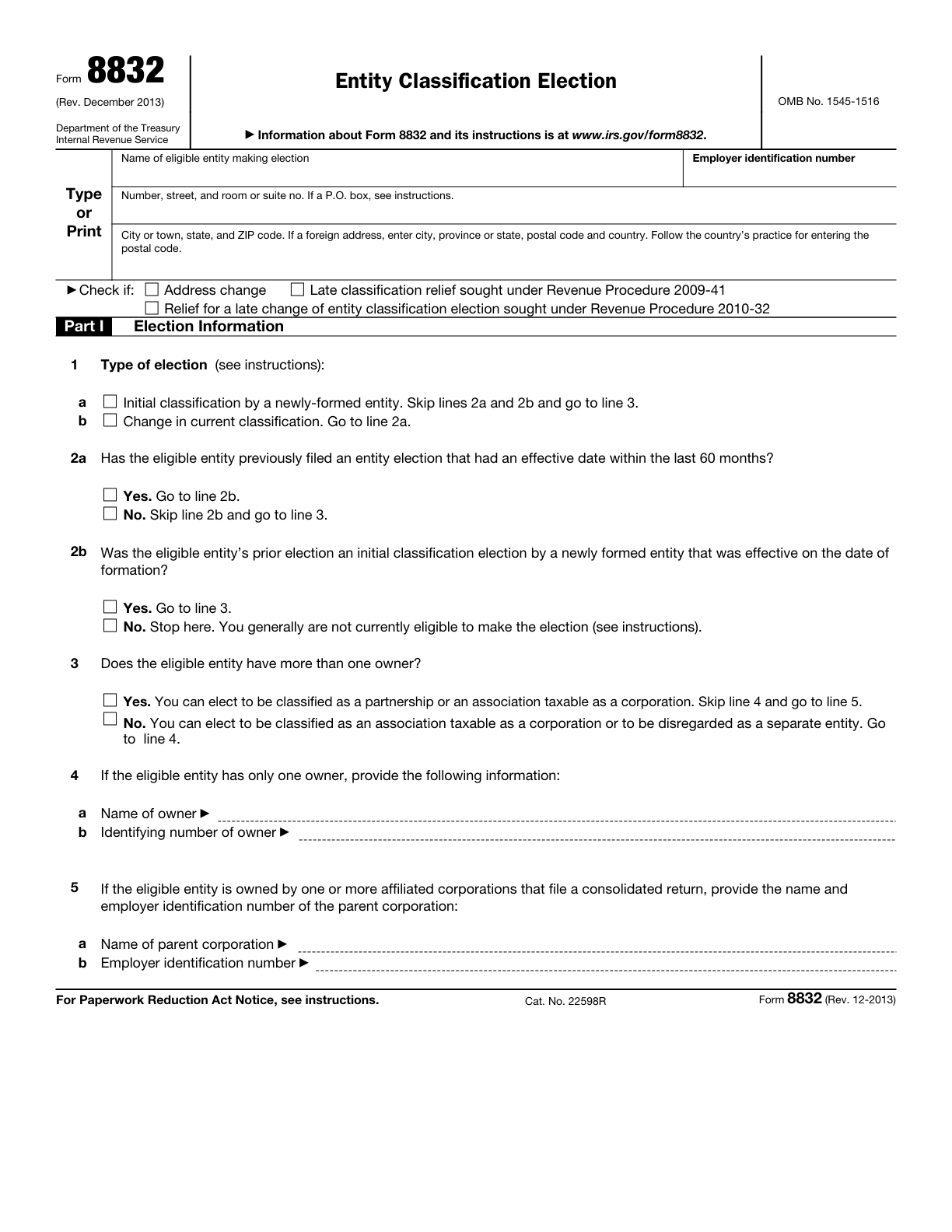
Read the requirements in context
Ein required
Form 8832 requires the entity's own EIN; Applied For is not accepted. An entity that already has an EIN retains that EIN after a classification change.[2, p.7]
Default classification
A domestic single-member LLC generally defaults to an entity disregarded as separate from its owner; a domestic LLC with two or more members generally defaults to partnership classification.[1, p.3]
Foreign owned us de definition
A foreign-owned U.S. disregarded entity is a domestic disregarded entity wholly owned by a foreign person. Its treatment as a corporation for these purposes is limited to the reporting requirements related to section 6038A.[3, p.2]
De proforma required
A foreign-owned U.S. DE subject to Form 5472 filing attaches Form 5472 to a pro forma Form 1120 and files by the Form 1120 due date, including a valid extension.[3, p.2]
A worked preparation example
This example is hypothetical; it shows how to organize the facts, not an agency decision.
Suppose an owner has the formation documents, an EIN notice and a saved return packet but cannot find a classification-election file. The history register records each item by date and purpose. The preparer looks for an actual Form 8832 copy, any related IRS response and references in the retained return records, without inventing an acceptance date when none is available. The SS-4 checkbox is recorded as application information rather than promoted into an election. A pro forma 1120/5472 packet is labelled by its special reporting purpose instead of being assumed to prove ordinary corporate classification. The owner and preparer also identify what ownership facts are known and which period any possible election may concern. If documents conflict, the register lists the conflict and the evidence needed to clarify it. This hypothetical does not decide that the entity must file Form 8832, assume that a tax return conclusively overrides an earlier election or prescribe an amendment to past filings. It produces a chronology that distinguishes established facts, plausible document leads and unresolved classification questions, making the next request for help specific enough to assess.[1, p.4] [2, p.5] [2, p.2] [2, p.7]
Turn the records into a usable filing plan
Complete the history review before treating classification change as the desired outcome. A standard election-preparation service should receive a supported description of the current position and the treatment the reader has chosen with an adviser, not a request to guess which tax status is best. Existing EINs are retained after a classification change, and Form 8832 requires the entity's own EIN rather than Applied For. Applicable consent signatures and return-copy requirements remain separate preparation steps, including the possibility of former-owner consents for a retroactive period. Keep the 60-month rule and its exceptions in the review rather than assuming another election is available because the file is incomplete. SpeedEIN's relevant standard scope is a U.S. single-individual-owner LLC election after the treatment has been chosen; it does not promise an S election, late relief or tax-planning recommendation. The deliverable here is a documented current-history question and a service-scope decision, not an unsupported classification verdict.[1, p.4] [2, p.5] [2, p.2] [2, p.7]
Three checks before you proceed
- Which records actually evidence an election or IRS response, and which merely describe application or filing information?
- Have a pro forma reporting packet, default treatment and a potential 60-month restriction been distinguished correctly?
- Is the next task to resolve missing history or prepare a chosen, supported election, rather than obtain an unoffered tax-planning recommendation?
Related preparation guides
- Changing Tax Classification While Keeping the EIN: Avoid Buying the Wrong Application
- Track a Form 8832 Decision From Mailing Evidence to the IRS Letter
- Build a Form 8832 Decision File: EIN, Ownership, Dates, and Intended Classification
Official sources and document versions
Official source versions checked: 2026-11-10
- Instructions for Form SS-4 (Rev. December 2025) — Rev. December 2025
- Form 8832 (Rev. December 2013) — Rev. December 2013
- Instructions for Form 5472 (Rev. December 2024) — Rev. December 2024
Get help with the relevant SpeedEIN service
SpeedEIN provides preparation and support within the scope described on its service pages. Review the supported entity types, required information and current service scope before ordering. IRS decisions, processing and any applicable filing or payment obligations remain governed by the official rules.