Initial Election or Change of Existing Classification? Read the Form 8832 Branch First
· 5 min read
The answer for this situation
The words initial and first can sound interchangeable when someone is completing an election for the first time. The form asks a more specific question. An LLC may be newly formed, may have operated under its default classification for years, or may already have an earlier election in effect even if its current owner has never seen the paperwork. Build the starting-state record before deciding which branch describes the requested work. That record should explain the formation date, the treatment supported by available documents and any earlier election. It is more useful than a single answer saying this is the first form I have personally submitted.[1, p.2] [1, p.7]
Which facts change the answer?
Form 8832 distinguishes an initial classification by a newly formed entity from a change in current classification. The default domestic-entity rules, the ordinary effective-date window and the restrictions connected to a prior election must all be considered within their stated scope. A newly formed eligible entity keeping its default treatment normally does not file merely because it was formed. The 60-month rule has exceptions requiring separate attention, including the specified initial election effective on formation. These points do not recommend a tax treatment. SpeedEIN's standard service assumes the eligible single-individual-owner LLC has already made that choice with an adviser and does not include late-election relief or an S election.[1, p.2] [1, p.7]
The official requirements, compared
| Question or field | Official instruction | Conditions and limits | Source |
|---|---|---|---|
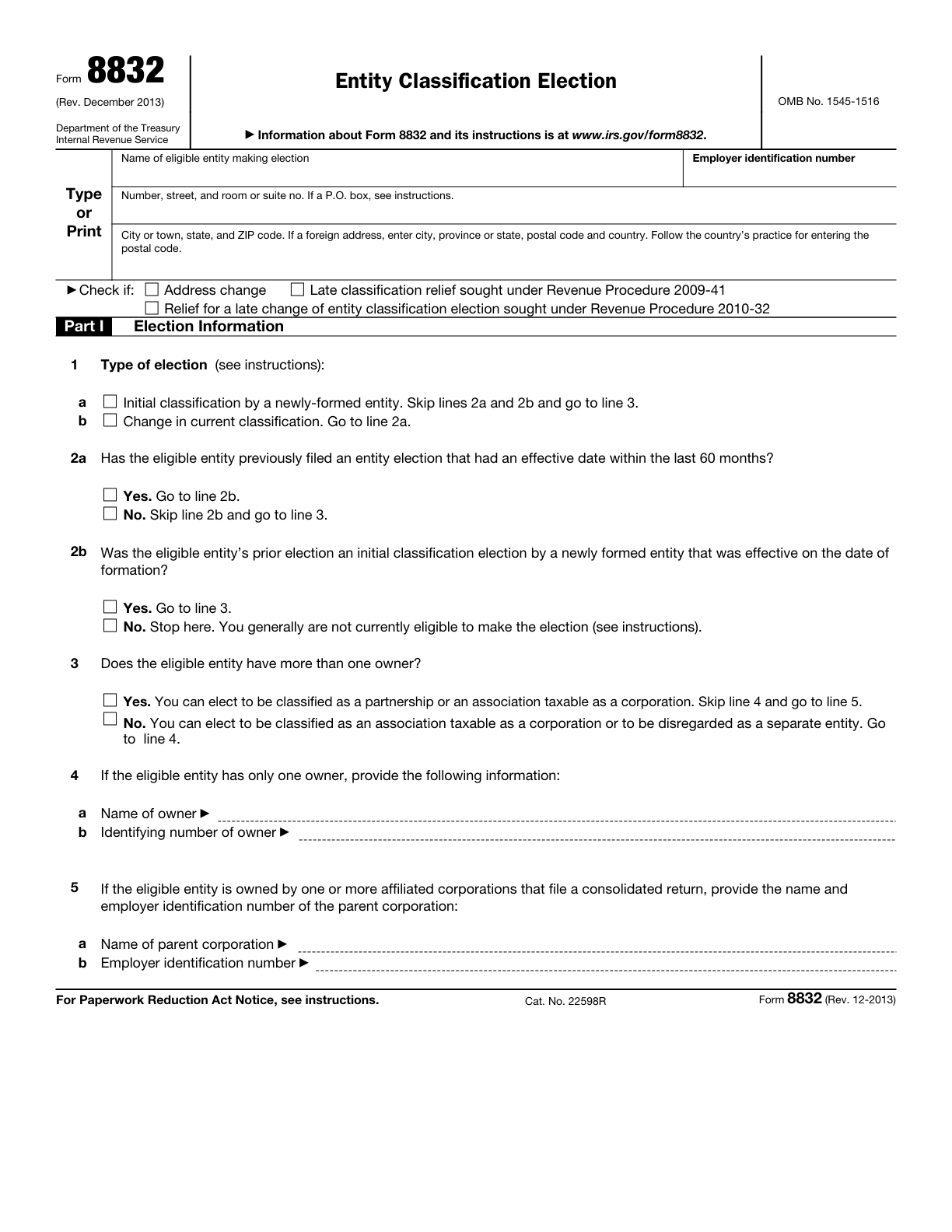
| Official field 8832 1a: Initial classification by a newly-formed entity. | A newly formed entity making an initial election selects this item and follows the form's instruction to skip lines 2a-2b and continue to line 3. First check whether its default classification makes an election unnecessary. | — | [1, p.2] |
| Official field 8832 1b: Change in current classification. | Select this item to change the existing classification and continue to line 2a. | — | [1, p.2] |
| 60 month change limit | A prior classification election effective within the preceding 60 months generally restricts another classification change. Apply the instructions' exceptions separately, including an initial election by a newly formed entity effective on its formation date. | — | [1, p.2] [1, p.7] |
| Default not required | A newly formed eligible entity accepting its default classification does not file Form 8832 merely because it was newly created. | — | [1, p.5] |
| Domestic default | Without an election, a domestic eligible entity with two or more members generally defaults to a partnership; one with a single owner generally defaults to a disregarded entity. | — | [1, p.5] |
| Effective window | An ordinary Form 8832 effective date generally cannot precede filing by more than 75 days or follow filing by more than 12 months. Late-election relief is a separate exception requiring its own review. | An ordinary Form 8832 election. Late-election relief for applicants meeting its conditions. | [1, p.6] |
Read the requirements in context
Official field 8832 3: Does the eligible entity have more than one owner?
Answer using the actual number of owners and follow the Yes/No directions to line 5 or 4. The available classifications depend on the owner count.[1, p.2]
Consent signatures
Obtain the Form 8832 consent signatures required from applicable members or owners, or an appropriately authorized person. A retroactive effective period can require consent from former owners as well.[1, p.7]
A worked preparation example
This example is hypothetical; it shows how to organize the facts, not an agency decision.
Consider two hypothetical owners who both say they need their first 8832. Nora formed an LLC recently and has documents addressing the treatment she wants from its beginning. Owen purchased an older LLC and has no copy of any prior tax election. Their personal experience of filing is similar, but their preparation files are not. Nora compares the formation date, proposed effective date and applicable initial-election conditions rather than assuming that any date in the first year qualifies. Owen first requests the company's earlier elections, IRS decisions and relevant returns. He cannot establish that no election exists just because none was included in the seller's first email. Both owners build a short starting-state statement that distinguishes confirmed documents from unanswered history questions. The statement then supports selection of the appropriate branch and review of the requested effective date. If Owen's records reveal an election within the relevant period, that information is assessed before a new draft is signed. If Nora wants to keep default treatment, the need for an election is reconsidered rather than filing one as a routine formation formality. The examples illustrate different evidence paths, not approval of either proposed date or classification.[1, p.2] [1, p.7]
Turn the records into a usable filing plan
Use the company's history, rather than the owner's memory of dealing with a preparer, to describe the starting point. Keep the formation record, earlier election history and chosen effective date visibly linked. A missing response from an earlier provider remains a missing fact; it is not evidence that default treatment necessarily continued. When requesting the standard service, explain what has been confirmed and what is uncertain before paying or signing. Preparation should follow the supported branch after the treatment decision and eligibility review, not manufacture certainty by choosing a checkbox first. Where the case involves another owner type, late relief, an S election or an unresolved tax consequence, obtain the relevant review outside this standard scope.[1, p.2] [1, p.7]
Three checks before you proceed
- Does initial describe the entity's actual situation, or only the owner's first experience filing?
- What supports the current classification and the company's earlier election history?
- Has the requested date been reviewed under the applicable window, prior-election rule and any relevant exception?
Related preparation guides
- Track a Form 8832 Decision From Mailing Evidence to the IRS Letter
- Returning to Disregarded Treatment: Prepare the Prior-Election and Adviser File First
- Before Form 8832: Does the LLC Already Accept Its Default Classification?
Official sources and document versions
Official source versions checked: 2026-11-10
- Form 8832 (Rev. December 2013) — Rev. December 2013
Get help with the relevant SpeedEIN service
SpeedEIN provides preparation and support within the scope described on its service pages. Review the supported entity types, required information and current service scope before ordering. IRS decisions, processing and any applicable filing or payment obligations remain governed by the official rules.