Tax Estimates on Form 7004: Identify Whose Liability the Numbers Describe
· 5 min read
The answer for this situation
Before entering tax estimates on Form 7004, identify the particular return and taxpayer those entries concern. A number from the owner's separate tax worksheet is not automatically an estimate for the entity return being extended, and an unknown amount should not become zero merely because the LLC is described as disregarded. A useful estimate record connects the intended return, the information used, the payments or credits being considered and any unresolved basis for the figures. It makes clear which questions are about the form's applicable instructions and which belong to a separate owner-level analysis. The purpose is to support a correctly scoped preparation task, not to infer a full income-tax position from the limited reporting treatment used for a foreign-owned DE package.[1, p.1] [2, p.3]
Which facts change the answer?
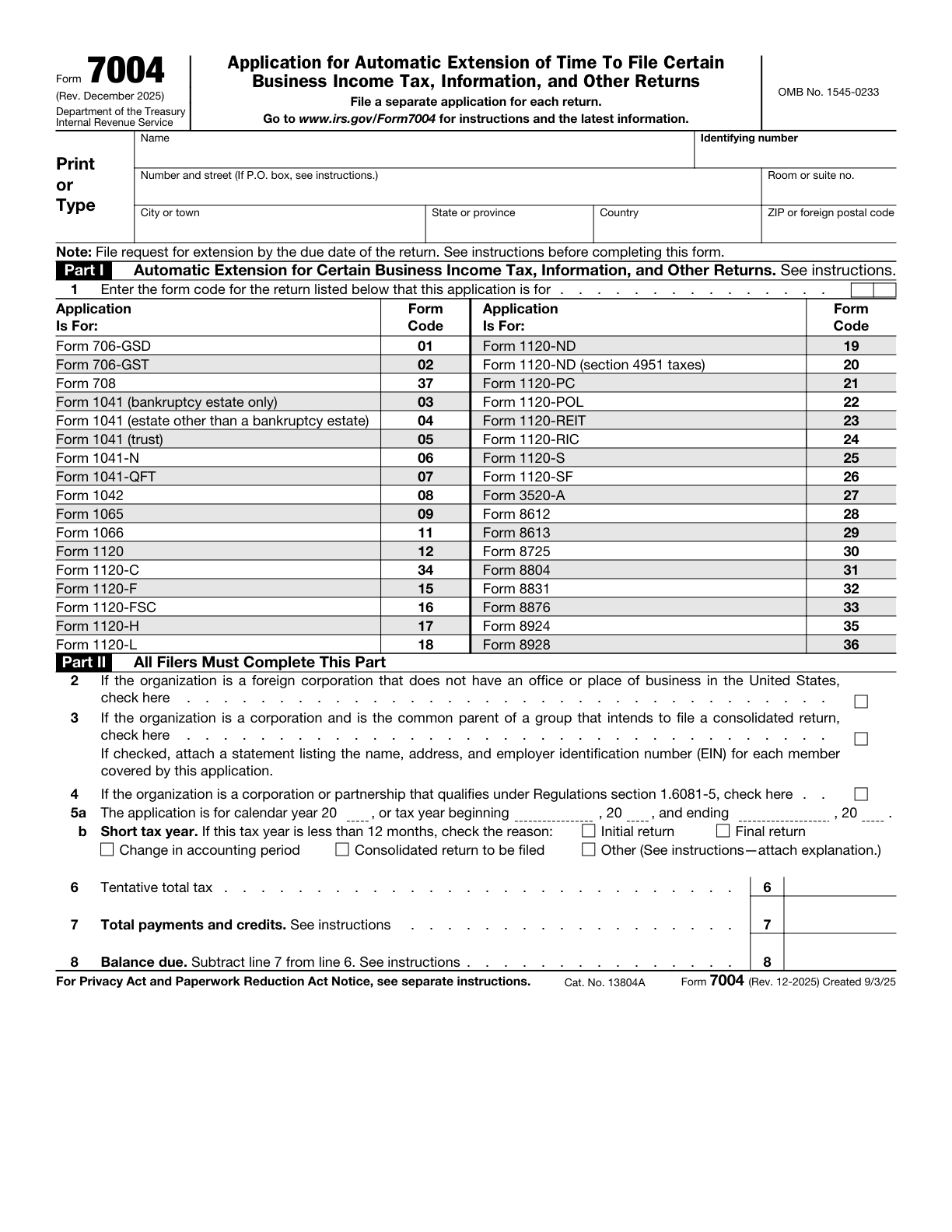
The selected Form 7004 fields distinguish estimated tax, relevant payments and refundable credits, and the resulting balance under the applicable instructions. The filing extension does not extend the deadline for paying tax due. This article does not calculate a personal liability, determine an unsupported entity tax amount or turn the special pro forma package into ordinary corporate income-tax preparation. An estimate of zero requires its actual basis; the form name or a service label is not that basis. Any uncertainty about which instructions govern the entries should remain a question for appropriate review rather than being concealed in a neat arithmetic result.[1, p.1] [2, p.3]
The official requirements, compared
| Question or field | Official instruction | Conditions and limits | Source |
|---|---|---|---|
| Official field 7004 6: Tentative total tax | Enter the estimated total tax for the year, applying the instructions for nonrefundable credits. Enter 0 only if that estimate is zero, not simply because of the form's name. | — | [1, p.1] [2, p.3] |
| Official field 7004 7: Total payments and credits. See instructions | Enter total payments and refundable credits, classifying them under the instructions for the return being extended. | — | [1, p.1] [2, p.3] |
| Official field 7004 8: Balance due. Subtract line 7 from line 6. See instructions. | Subtract line 7 from line 6 to determine the balance. Form 7004 does not extend the payment deadline. | — | [1, p.1] [2, p.3] |
| Not payment extension | Form 7004 does not extend the deadline for paying tax due. | — | [2, p.2] |
| Separate return | File a separate Form 7004 for each type of return requiring an extension. The extension applies only to the form selected on Part I, line 1. | — | [2, p.1] |
| De proforma required | A foreign-owned U.S. DE subject to Form 5472 filing attaches Form 5472 to a pro forma Form 1120 and files by the Form 1120 due date, including a valid extension. | — | [3, p.2] |
Read the requirements in context
Foreign owned us de definition
A foreign-owned U.S. disregarded entity is a domestic disregarded entity wholly owned by a foreign person. Its treatment as a corporation for these purposes is limited to the reporting requirements related to section 6038A.[3, p.2]
Records sufficiency
Keep permanent books and records sufficient to establish the correctness of the federal return and the treatment of related-party transactions, together with the detailed requirements of Regulations section 1.6038A-3.[3, p.3]
A worked preparation example
This example is hypothetical; it shows how to organize the facts, not an agency decision.
Suppose a hypothetical owner provides a personal tax estimate, an LLC bookkeeping summary and a prior extension draft, asking the preparer to reuse whichever figures are convenient. The preparer first labels each source by the taxpayer, return and period it describes. A personal estimate is not transferred into the entity application solely because the owner funded the LLC. A prior zero is treated as information needing context, not as a standing instruction for every future year. The preparer then identifies what supports the entries appropriate to the selected return and which payments or credits, if relevant, belong in that calculation. Arithmetic is checked only after the inputs have been scoped; subtracting two unrelated numbers accurately would not resolve the underlying problem. If the basis remains unknown, the working record names the missing fact instead of inventing a zero to finish the draft. This hypothetical review creates a traceable estimate question and separates it from the owner's other tax matters. It does not determine that the owner owes tax, that the entity has a particular liability or that payment can wait until the extended filing date.[1, p.1] [2, p.3]
Turn the records into a usable filing plan
Ask for an explanation of what each input represents before asking whether the final balance looks plausible. Keep an estimate, a payment record and an owner-level computation identifiable as different items. Where a figure comes from a prior period or another return, describe that limitation and obtain the appropriate current basis before relying on it. Do not use the limited corporate reporting treatment of a foreign-owned DE as a shortcut to an ordinary corporate income-tax calculation or a broad no-tax assertion. SpeedEIN's supported filing-extension preparation should be discussed within its stated scope and original-deadline requirements; it does not offer personal tax preparation or additional time to pay through the extension request. The useful outcome is a record showing which entries are supported and which substantive tax questions need separate attention.[1, p.1] [2, p.3]
Three checks before you proceed
- Which taxpayer, return and period does each proposed estimate, payment or credit actually concern?
- What supports a zero or another figure under the applicable instructions, rather than the LLC label or a copied prior draft?
- Have payment timing and any separate owner-level tax question remained outside an assumed entity filing extension?
Related preparation guides
- The LLC's Extension and the Owner's Return Are Different Filing Jobs
- The Extension Was Requested: Define the Remaining Annual-Filing Deliverables
- Form 7004 Extends Filing Time, Not the Time to Pay
Official sources and document versions
Official source versions checked: 2026-11-10
- Form 7004 (Rev. December 2025) — Rev. December 2025
- Instructions for Form 7004 (Rev. December 2025) — Rev. December 2025
- Instructions for Form 5472 (Rev. December 2024) — Rev. December 2024
Get help with the relevant SpeedEIN service
SpeedEIN provides preparation and support within the scope described on its service pages. Review the supported entity types, required information and current service scope before ordering. IRS decisions, processing and any applicable filing or payment obligations remain governed by the official rules.